

Mastering Google Ads for Moving Companies: A PPC Lead Gen Blueprint
Google Ads for moving companies captures high-intent searchers at the exact moment they need a mover, turning searches into predictable, bookable leads when campaigns are built around intent, geography, and measurement. This guide explains why paid search is essential for movers, how to structure campaigns for local and long-distance moves, and which strategies improve return on ad spend while lowering cost per lead. Many moving companies struggle to convert web traffic into qualified bookings because their campaigns mix intent signals, overlook negative keywords, or lack proper conversion tagging; this guide solves those problems by mapping campaign design to measurable KPIs. You will learn campaign templates, keyword research methods, bidding and creative tactics, budget tiers with CPL benchmarks, and advanced options like Local Service Ads and remarketing sequences. The article includes practical step-by-step setup, decision tables for bidding and campaign types, and agency-vetting checklists so owners can decide whether to run PPC in-house or engage a specialist. Throughout, terms like moving company PPC, moving company CPC, and local service ads movers are used in context to help you implement a results-driven Google Ads program.
Why Are Google Ads Essential for Moving Companies?
Google Ads are essential for moving companies because paid search directly connects intent-rich queries—like “book local movers” or “long-distance moving quote”—to immediate contact options, improving both speed and quality of lead acquisition. When a prospect types an offer-driven query, search ads match that intent and present call extensions, lead forms, or a conversion-optimized landing page that shortens the funnel from awareness to booking. This mechanism delivers predictable volume on demand and complements organic SEO and local pack visibility by filling short-term capacity and seasonal spikes. For movers, the practical benefit is the ability to scale lead volume by geography and service type while preserving measurable CPL and ROI through conversion tracking and attribution.
What Benefits Do Google Ads Offer Moving Companies?
Google Ads deliver specific, measurable benefits for movers that support both short-term revenue and long-term customer acquisition pipelines. Paid search captures immediate demand that organic channels take months to develop, providing near-instant visibility for transactional queries and the flexibility to shift spend by route, city, or season. Ads enable granular geo-targeting and scheduling so companies can promote same-week availability or off-peak discounts to boost utilization. Finally, ad extensions and lead forms reduce friction, increasing phone calls and quote submissions directly from the search results.
- Immediate visibility for high-intent queries during peak booking windows.
- Granular local targeting and radius bidding to prioritize nearby jobs.
- Ad extensions (call, lead form) that convert searchers into booked estimates quickly.
- Seasonal scaling to increase capacity during moving peaks and reduce spend in slow months.
These advantages support a predictable lead pipeline, and understanding them leads naturally to campaign structure choices that align with local versus long-distance moves.
How Does Paid Traffic Improve Moving Lead Generation?
Paid traffic improves moving lead generation by matching user intent to an optimized conversion flow: targeted keyword → relevant ad copy → dedicated landing page → defined conversion action (call, form, booking). This funnel reduces time-to-contact and filters out low-intent traffic through negative keywords and ad relevance, raising lead quality. For example, a hypothetical campaign in a mid-size metro spending $6,000/month with a 12% lead rate and $120 CPL could produce roughly 50 qualified leads, illustrating how budget, CTR, and conversion rate interact. The rapid testing cycle of Google Ads also allows movers to iterate on headlines, offers, and landing pages, quickly zeroing in on the messaging and geographies that deliver the best CPL.
Indeed, the inherent design of PPC, with its focus on measurable interactions and strategic targeting, is what makes it so effective for optimizing lead generation.
Google Ads & PPC: Targeting, Conversion Tracking, and ROI
Pay-Per-Click (PPC) advertising further enhances cost-effectiveness by charging advertisers only when users interact with ads, aligning expenditures with measurable outcomes. Conversion tracking plays a critical role in evaluating campaign success, providing insights into user actions post-click to refine strategies and improve ROI. Strategic keyword selection and tools such as the Google Keyword Planner empower advertisers to refine targeting, enhance ad performance, and achieve marketing objectives effectively.
Using google ads in digital marketing, K Solberg Söilen, 2024
The ability to measure each step of this funnel—impressions, clicks, form completions, calls—enables continuous optimization and ties ad spend directly to booked jobs and revenue, which is essential for sustainable lead generation.
How to Set Up Effective Google Ads Campaigns for Moving Businesses?

To set up effective Google Ads campaigns for moving businesses, start by separating local search intent from long-distance intent and by tagging conversions so every paid interaction maps to a measurable lead event. Structured accounts reduce overlap, prevent wasted spend from broad or irrelevant queries, and support smarter bidding decisions. Targeting should combine radius and city-level targeting for local moves and origin/destination based keywords for long-distance routes, with negative keywords preventing irrelevant traffic. Proper setup includes GA4/GTM tagging, phone-call tracking, and clear KPIs such as CPL, lead volume, and conversion-to-job rate.
- Start here: Three-step campaign setup
- Create campaign templates for local and long-distance
- Implement conversion tracking and negative keyword lists
These three steps create a foundation for scalable campaigns that prioritize high-intent queries and measurable outcomes. The next subsections detail structure templates and keyword research methods that fit these steps.
What Is the Best Campaign Structure for Local and Long-Distance Moves?
The best campaign structure separates local moves into city- or ZIP-based campaigns and treats long-distance moves as route or origin-destination campaigns to maintain relevance and bidding control. For local services, organize campaigns by service (residential moves, labor-only, packing) and ad groups by city or neighborhood, using radius targeting and call extensions for immediate contact. For long-distance, organize ad groups by origin-destination pairs or route themes, with keywords that include “long distance movers” plus specific origin/destination cities; this reduces keyword cannibalization and allows precise bidding by route profitability. Use negative keywords to exclude apartment-only or DIY queries and configure conversion tracking for both form submissions and tracked phone calls.
This campaign organization improves ad relevance and allows you to prioritize profitable routes while controlling wasted spend.
How to Conduct Keyword Research for High-Intent Moving Keywords?
Keyword research for movers focuses on transactional, location-specific queries that indicate booking intent and a readiness to buy. Start with seed keywords like “local movers near me,” “book movers [city],” and “long distance moving quote,” then expand using Keyword Planner and search-term reports to find variations and high-intent modifiers such as “same-day,” “estimate,” and “licensed insured.” Prioritize exact and phrase match types for core transactional terms while using broad match with smart bidding cautiously and backed by performance data. Build a negative keyword list early that excludes rental equipment, storage-only queries, and DIY moving terms to preserve budget for qualified prospects.
- Prioritize money-intent modifiers (book, quote, hire) with city names.
- Use match types strategically: exact/phrase for core terms; broad+smart bidding for expansion if conversions exist.
- Maintain a negative keyword list to exclude unrelated services and avoid wasting spend.
Refining keywords by seasonality and neighborhood names further improves targeting and reduces CPL, which leads into bid strategy selection for ROI optimization.
What Are the Best Google Ads Strategies for Movers to Maximize ROI?
Maximizing ROI for moving companies requires coordinating ad copy, ad extensions, bidding strategies, and conversion-driven landing pages so each click has a high probability of turning into a booked job. Ad copy must reflect local intent, emphasize availability or guarantees, and use strong CTAs that align with landing page forms or call actions. Ad extensions—call, sitelink, structured snippets—expand real estate in search results and increase click-through rates, while landing pages optimized for fast lead capture reduce drop-off. Bidding should match business maturity: manual or maximize clicks for low-data accounts, and Target CPA/Maximize Conversions for accounts with robust conversion history and reliable tracking.
After implementing these tactics and testing iterations, the next paragraph connects education to agency assistance for those who prefer outside expertise. Stacked SEO is a digital marketing agency built on data, AI, and creativity, with a mission to drive measurable growth, more leads, and lasting visibility for brands. They specialize exclusively in SEO for moving companies, offering services like SEO for Movers and AI Search Optimization (GEO for Movers). Their strategies are designed to help moving companies outrank national van lines, local competitors, and lead vendors. The accessible site content highlights ‘SEO for Movers’ and ‘AI Search Optimization (GEO for Movers)’; ‘PPC For Movers’ is mentioned as an offering but a dedicated deep-dive PPC guide is not present.
How to Craft Compelling Ad Copy and Use Ad Extensions?
Compelling ad copy for movers combines service, location, urgency, and a clear CTA that matches the landing page conversion goal, and ad extensions amplify those signals to increase clicks and conversions. Use headlines that include the service and city (for example, “Residential Movers — [City] Estimates Today”) and descriptions that highlight availability, price transparency, or moving guarantees to reduce friction. Implement call extensions and lead form extensions for mobile-first contacts, and use sitelinks to surface packing services, long-distance quotes, and customer reviews. Structured snippets can list service types (local, long-distance, packing), while callouts highlight unique selling points such as “Licensed & Insured” or “Same-week availability.”
- Lead with service + location + CTA in headlines.
- Use call and lead form extensions to capture immediate contact.
- Match ad copy messaging to the landing page to preserve quality score and reduce bounce.
These copy and extension practices increase relevance and feed better signals into Google’s auction, which supports smarter bidding and lower CPL.
Which Bidding Strategies Optimize PPC Performance for Moving Companies?
Choosing the right bidding strategy depends on conversion volume, tracking fidelity, and business goals—volume versus efficiency. Low-data accounts often begin with Manual CPC or Maximize Clicks to collect conversion data, then migrate to Target CPA or Maximize Conversions once conversion tracking and lead-to-job rates are stable. Target ROAS is appropriate if you can reliably attach revenue to each booking and want to optimize for revenue rather than raw lead count. Enhanced CPC can act as a transition between manual control and automated bidding, allowing some automation while retaining manual oversight.
- Decision steps for bidding strategy
- Match business maturity to bidding method
- Monitor and pivot based on conversion quality and CPL
This decision framework helps align bids with business objectives and available data, and it transitions naturally to budget planning and expected costs described next.
This table clarifies which strategies suit your maturity level and conversion volume expectations.
How Much Does PPC Cost for Moving Companies and How to Budget?
Budgeting for PPC in moving companies depends on market competitiveness, service type, and geographic scope, but a tiered approach helps estimate expected leads and CPL for planning. Search CPCs for movers in 2024 benchmark between roughly $8 and $22 per click, while Local Service Ads (LSA) often present different CPL dynamics with ranges generally lower for local intent but variable by verification and market. Model budgets by company size—new/small, mid, and large fleets—estimating leads per month and expected CPL ranges to understand how many campaigns and routes you can sustain.
Below is a practical comparison of company sizes, recommended monthly ad budgets, and expected leads/CPL ranges to help owners model return on ad spend.
This budget table demonstrates how increased spend typically reduces CPL through optimization and scale, while smaller budgets require tighter geo-targeting and conservative bidding to preserve lead quality.
For companies looking for modeling and forecasting assistance, Stacked SEO is a digital marketing agency built on data, AI, and creativity, with a mission to drive measurable growth, more leads, and lasting visibility for brands. They specialize exclusively in SEO for moving companies, offering services like SEO for Movers and AI Search Optimization (GEO for Movers). Their strategies are designed to help moving companies outrank national van lines, local competitors, and lead vendors. The accessible site content highlights ‘SEO for Movers’ and ‘AI Search Optimization (GEO for Movers)’; ‘PPC For Movers’ is mentioned as an offering but a dedicated deep-dive PPC guide is not present.
What Is the Average Cost Per Click and Cost Per Lead for Movers?
Average costs for movers vary significantly by geography and intent: search CPCs in competitive metros trend higher, and CPL depends on conversion rate and lead quality. As a working benchmark in 2024, search CPCs range from $8–$22, while Search CPLs often fall between $63–$200 depending on offer and market. LSAs may show CPLs in the $25–$60 window in some markets due to their high-intent nature, but this varies with verification and lead handling practices. Factors that increase CPC/CPL include dense metro competition, peak moving season, and lack of negative keywords or poor landing page relevance.
These ranges are starting points; actual performance must be modeled against your lead-to-job conversion rate to estimate ROI accurately.
How to Calculate ROI and Track Google Ads Conversions Effectively?
Calculating ROI for movers requires linking ad-driven leads to booked jobs and average job value; ROI = (Revenue from booked jobs − Ad spend) / Ad spend. Set up conversion tracking in GA4 with Google Tag Manager, track phone calls via call tracking or Google forwarding numbers, and import offline conversion data from your CRM to reflect booked jobs rather than raw leads. Use attribution windows and multi-touch attribution where possible to account for research-heavy buyer journeys, and define a realistic lead-to-job conversion rate based on historical data to translate CPL into cost-per-job and ROAS.
- Ensure GA4 + GTM conversion events are defined for form, call, and booking
- Import offline conversions to attribute booked jobs to ad clicks
- Calculate CPL → cost-per-job using lead-to-job conversion rate then derive ROAS
Consistent, accurate tracking converts campaign metrics into business decisions and supports automated bidding strategies that rely on high-fidelity conversion signals.
How Can Advanced Google Ads Tactics Boost Moving Company Lead Generation?
Advanced Google Ads tactics—Local Service Ads, layered remarketing, audience signals, and AI-driven automation—boost lead quality and scale when used with rigorous measurement and sequencing. LSAs capture immediate local intent and often result in higher-quality leads when verification and lead handling are optimized. Remarketing sequences recapture site visitors who viewed pricing or quote pages, using tailored messaging to move them down the funnel. Audience signals and first-party lists (Customer Match) inform smart-bidding models and help grow lookalike audiences for expansion.
What Are Local Service Ads and How Do They Benefit Movers?
Local Service Ads (LSA) operate on a lead-based model and appear at the top of local searches, connecting consumers directly with verified local providers—this increases visibility among high-intent local searchers. LSAs require provider verification and have a distinct lead billing model, and their leads often convert at higher rates because users contact providers directly through the platform. For small movers, LSAs can be an efficient way to capture nearby, service-ready customers; for larger operations, LSAs complement search campaigns to cover full-funnel local demand. The trade-off is that LSA leads may cost more per lead in certain markets but typically return better conversion quality.
Understanding LSA mechanics helps movers decide whether to allocate separate budgets to this high-intent channel.
How to Use Remarketing and Audience Targeting for Moving Businesses?
Remarketing and audience targeting let movers re-engage prospects who interacted with pricing pages, route estimators, or booking forms, moving them toward a conversion with sequential messaging and offers. Segment visitors into audiences—quote page visitors, pricing page visitors, and partial form abandoners—and create tailored ad sequences that address objections, offer seasonal discounts, or highlight guarantees. Use Customer Match to reach previous customers for upsell or referral campaigns, and apply similar audiences to scale into new, high-potential markets. Sequenced remarketing improves efficiency by lowering CPL for warmed prospects compared to cold search traffic.
- Segment audiences by page intent and engagement depth.
- Use sequential ads to answer objections and present offers over time.
- Leverage Customer Match and lookalike audiences for scaling.
These audience strategies close the gap between initial interest and booked jobs when paired with tailored landing pages and follow-up processes.
When and How to Choose a PPC Agency for Your Moving Company?
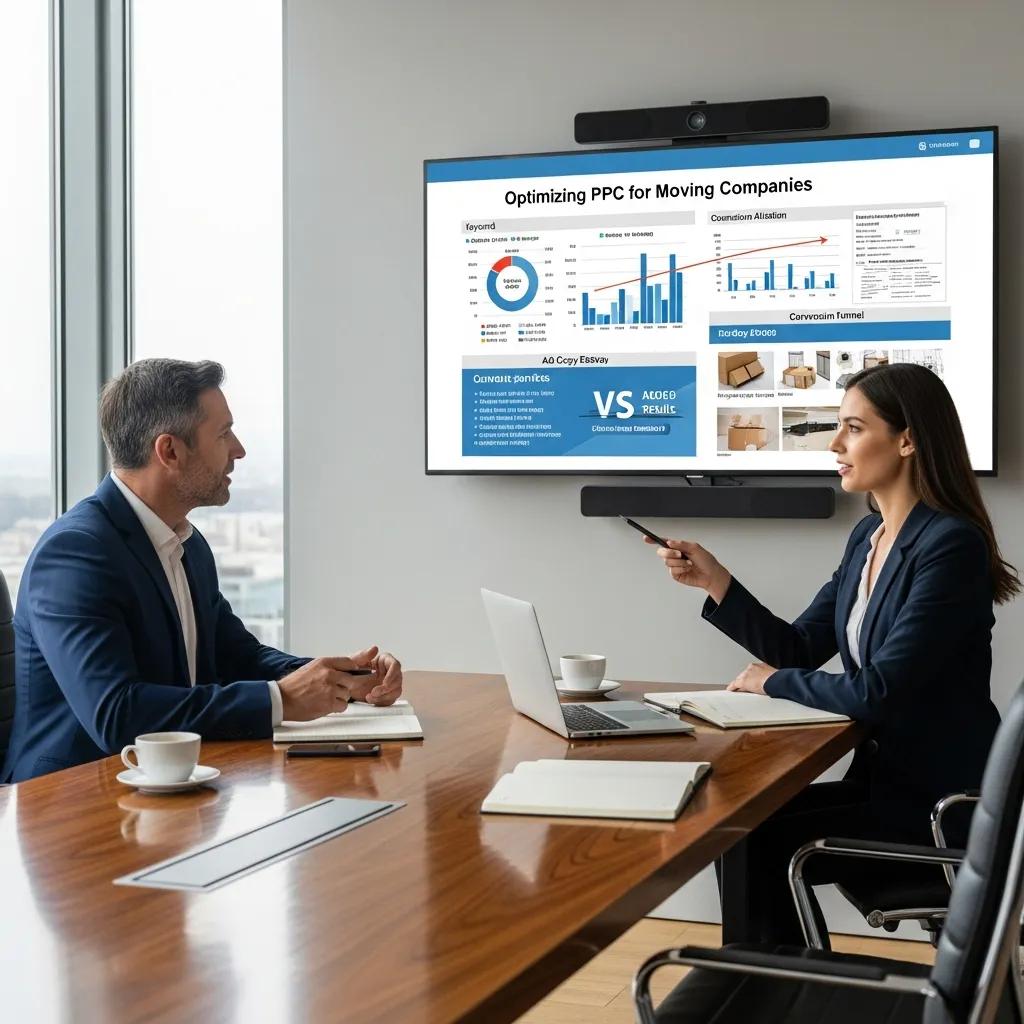
“When in-house is insufficient (lack of time/skills/scale)” is a decisive prompt for hiring external PPC expertise, especially when campaigns require advanced tracking, creative testing, or multi-market scaling. Use a checklist to evaluate agencies on mover-specific experience, tracking and reporting capabilities, transparency, and measurable results. Define trial engagement terms with clear KPIs, reporting cadence, and expected handoffs so both parties measure success consistently. Choosing an agency is a business decision about capacity and ROI; bring data on current CPL, lead volume, and operational conversion rates to any evaluation to help the agency create an accurate forecast.
The following checklist identifies practical vetting criteria to distinguish specialized partners from generalist vendors.
- Industry-specific case studies and mover experience
- Clear tracking and CRM integration capabilities
- Transparent reporting and agreed KPIs
- Structured trial engagements and scaling plans
These criteria focus selection on measurable outcomes and technical competency, preparing a company for either a pilot engagement or a managed growth relationship.
What Should You Look for in a PPC Agency Specialized in Moving Companies?
When vetting a PPC agency, prioritize mover-specific capabilities and technical depth that ensure reliable tracking and tangible CPL improvements. Look for demonstrated experience improving CPL and lead quality for moving companies, transparent reporting that ties ad spend to booked jobs, and technical ability to implement GA4, GTM, and CRM integrations. Request a seven-point checklist during vetting that covers case studies, tracking, reporting frequency, creative testing, bid strategies, contract flexibility, and references to explain process. Ask whether the agency builds negative keyword frameworks and maps campaigns by service and geography—these operational details matter more than generic ad management promises.
- Proven mover-specific case studies with measurable outcomes.
- Technical ability: tracking, CRM and call-tracking integrations.
- Transparent reporting, defined KPIs, and flexible trial terms.
This vetting approach reduces risk and speeds meaningful performance improvement when you engage a specialized partner.
How Does Stacked SEO Provide Expert Google Ads Management for Movers?
Stacked SEO is a digital marketing agency built on data, AI, and creativity, with a mission to drive measurable growth, more leads, and lasting visibility for brands. They specialize exclusively in SEO for moving companies, offering services like SEO for Movers and AI Search Optimization (GEO for Movers). Their strategies are designed to help moving companies outrank national van lines, local competitors, and lead vendors. The accessible site content highlights ‘SEO for Movers’ and ‘AI Search Optimization (GEO for Movers)’; ‘PPC For Movers’ is mentioned as an offering but a dedicated deep-dive PPC guide is not present.
Their positioning emphasizes industry specialization, data-driven processes, and AI-powered GEO optimization to help movers gain measurable visibility and qualified leads. When evaluating a partner, consider these strengths alongside the agency’s ability to model budgets, forecast CPL/ROI, and integrate tracking into your CRM so paid efforts convert reliably into booked jobs.
This final analysis ties agency selection back to campaign setup and measurement, enabling moving companies to choose between in-house execution and managed services based on capacity and growth goals.