

Stay Ahead of SEO Changes: Google Algorithm Updates & AI Search Optimization for Movers
Search behavior and ranking signals are changing fast as Google refines its algorithms and AI-driven answer features. Those shifts have a direct impact on how local moving companies win leads and rank for high‑intent searches. This guide breaks down the recent Google updates and AI search changes, shows the risks and opportunities they create for movers, and gives practical steps to protect and grow local visibility. You’ll get a target list of core updates to prioritize, how LLMs and AI answer surfaces change intent, the trends that deserve immediate attention (voice search, E‑A‑T, helpful content), and the monitoring cadence and tools to spot volatility before it hits conversions. Each section includes short triage checklists, clear implementation steps, and industry examples so you can act quickly and keep lead volume steady.
Stacked SEO
is a digital marketing agency focused on the moving industry. We combine data, AI, and creative execution to drive measurable growth, leads, and local visibility for movers. Our core offerings include
AI Search Optimization for Movers
and LLM Optimization, bundled into an all‑in‑one package that pairs SEO, PPC, AI voice agents, content strategy, and conversion tracking under a flat monthly rate. If you’re comparing partners, our vertical focus and AI systems shorten time‑to‑results and align content and local signals with how search actually behaves. The rest of this article is tactical guidance you can use on your own; the agency note above simply shows where a specialized partner can fit into your roadmap.
What Are the Latest Google Algorithm Updates in 2025 and How Do They Impact Moving Companies?
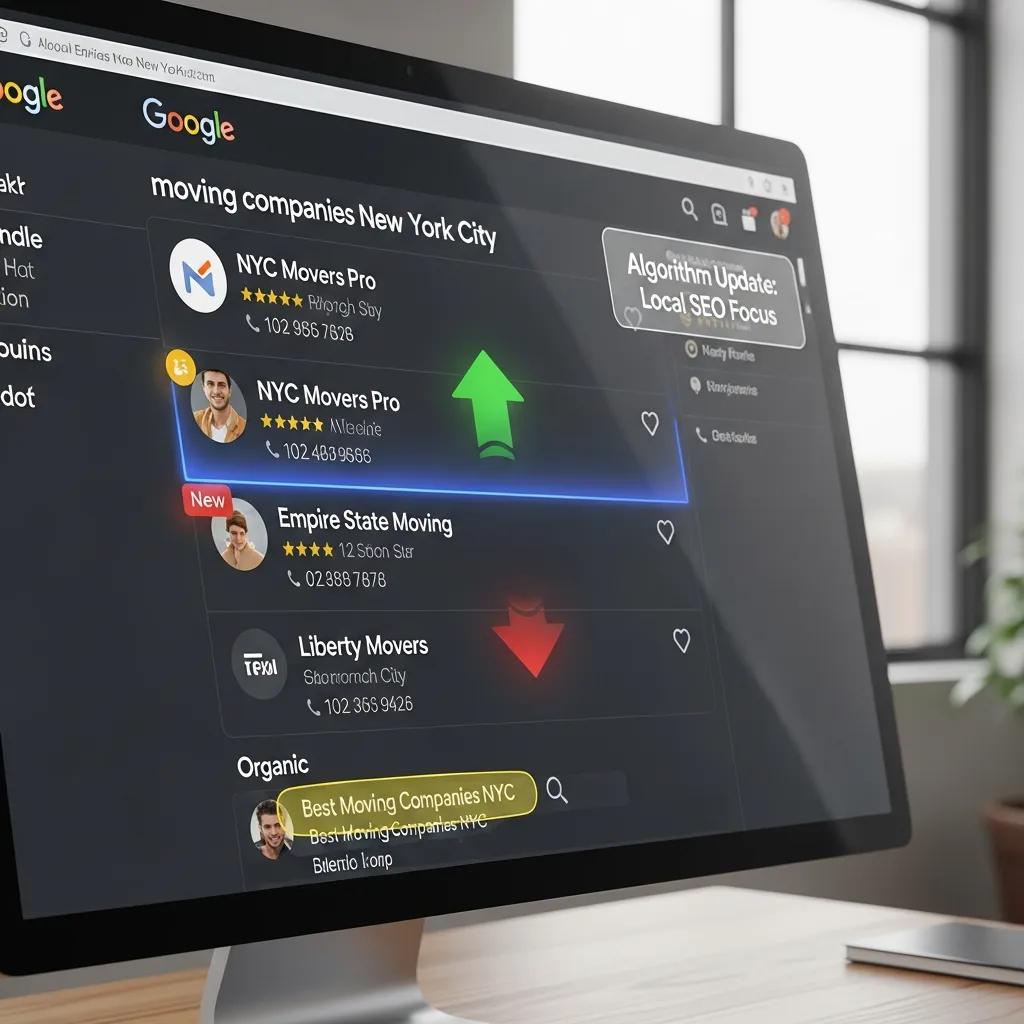
Google’s 2024–2025 update cycle put stronger emphasis on answer quality, local intent accuracy, and demoting low‑value pages. That means location‑specific, clearly authored moving content matters more than ever. At a technical level, Google rebalanced core ranking signals and increased the weight on entity clarity, helpful content that matches user intent, and reliable local signals. For movers, aligning to those shifts reduces ranking volatility and improves conversions by matching landing pages and GBP (Google Business Profile) data to real user queries. Below are the immediate impacts and quick triage actions movers should prioritize to stabilize organic and local visibility.
These ongoing shifts highlight persistent challenges in local SEO, especially around algorithm updates and mobile ranking.
Local SEO Challenges: Algorithm Updates & Mobile Ranking
Recent search engine algorithm changes have caused ranking fluctuations, and mobile remains a critical factor when implementing local SEO strategies. Small local variations in signals can lead to outsized shifts in visibility.
Are you local? The challenges of local search engine optimisation strategies, B Keegan, 2019
- Increased SERP volatility for generic service pages
: Audit thin service pages and consolidate duplicates so link equity and relevance aren’t diluted. - Higher penalty risk for unhelpful content
: Replace templated copy with local, use‑case specific pages that directly answer mover queries. - Greater weight on entity signals (GBP, citations)
: Standardize NAP and add local schema to improve map‑pack relevance. - AI answer extraction shifts traffic distribution
: Add concise, authoritative Q&A sections to capture AI‑surface snippets.
Quick remediation: (1) audit and merge thin pages, (2) verify and enrich GBP fields, (3) add structured data for services and service areas, and (4) create answer‑first content for common moving queries. These four steps reduce immediate risk and align your site to how Google and LLMs source local answers.
Which Key Google Core Updates Should Movers Know About?
Core updates from 2023–2025 centered on helpful content, relevance recalibrations, and localized answer quality. Each change adjusts how local service intent is measured and ranked. The Helpful Content updates continue to deprioritize content written for search engines rather than people—this hurts thin or templated service pages that lack specificity. Other core recalibrations shifted weight toward entity clarity and domain trust, and the December 2024 Core Update widened the influence of entity signals like GBP completeness, local citations, and clearly authored content.
- Helpful Content Update (post‑2022): Demotes non‑informative, templatey pages that don’t answer real user needs.
- Core relevance recalibrations (2023–2025): Shifted weighting toward entity clarity and domain‑level trust.
- December 2024 Core Update: Brought stronger local signal integration and emphasized AI‑sourced answer quality.
Fast mitigation: merge duplicate service pages, publish local case studies and clear author/owner transparency, and tighten GBP fields and citations to protect or recover rankings when these updates roll out.
How Does the December 2024 Core Update Affect SEO Strategies for Movers?
The December 2024 Core Update increased emphasis on entity resolution, refined local intent interpretation, and was tougher on low‑quality content. Movers should adapt across three fronts: content quality, local trust signals, and technical clarity. Practically, create service pages that answer top user questions with short, structured content; ensure GBP and citation consistency; and fix technical issues that block crawlers from understanding your service areas. For example, consolidate multiple thin “moving service” pages into clear, location‑specific pages with schema and local testimonials.
- Content: Replace templated blurbs with specific service workflows and localized outcomes.
- Local signals: Audit GBP attributes and keep NAP consistent across high‑value citations.
- Technical checks: Validate structured data, mobile speed, and crawlable service‑area pages.
These adjustments restore trust, clarify entity relationships, and align your site with the update’s focus on helpful, local‑first experiences.
How Is AI Search Optimization Transforming SEO for Moving Businesses?

AI Search Optimization means shaping content and technical signals so answers surfaced by large language models and AI‑assisted search point to your moving services. LLMs and AI systems favor high‑authority, well‑structured pages and knowledge‑graph style entity data, then synthesize concise answers for users. For movers, optimizing for AI search increases the chance that assistants and answer boxes route prospects to your booking options or contact methods—driving more qualified traffic and calls.
The wider use of AI in marketing shows clear business benefits—from data analysis to automation—when it’s applied strategically.
AI Marketing Strategies for Business Optimization
AI tools can help create smarter marketing strategies: better data analysis, personalization, automation of repetitive tasks, chatbots and virtual assistants, and ad optimization.
Optimizing business performance: Marketing strategies for small and medium businesses using artificial intelligence tools, 2024
- AI‑driven search rewards concise, factual contentthat answers queries directly.
- Structured data and entity clarityhelp AI systems attribute facts to the correct local business.
- Voice and assistant surfaces often show single‑source answers; being that source multiplies conversion opportunities.
To win in an AI‑first environment, create short, authoritative answer blocks, publish detailed local service pages with schema, and write conversational FAQ copy that mirrors how customers talk.
What Role Do Large Language Models Like ChatGPT and Google AI Mode Play in SEO?
Large language models act as answer synthesizers: they retrieve, paraphrase, and attribute information from indexed pages and entity graphs to produce direct responses. Their selection process favors well‑structured content and clear entity relationships. Practically, an LLM assistant will prefer pages with explicit Q&A sections, structured data, and authoritative citations when answering “best local movers near me.” That means visibility now depends not only on classic SERP position but also on concise answer units and strong local signals that LLMs can map to a single business.
- LLMs source content from high‑quality indexed pages and knowledge graphs.
- LLM answer selection favors explicit Q&As, structured snippets, and verified local profiles.
- Risk: ambiguous or duplicated content lowers the chance of being cited as the authoritative source.
Knowing how LLMs attribute sources lets movers design content that’s both indexable and referenceable by AI assistants—raising the probability of being the single answer in conversational results.
How Can Movers Leverage AI‑Driven SEO to Stay Competitive?
Movers can capture AI‑driven traffic by producing answer‑first content, applying precise structured data, and optimizing copy for voice‑friendly phrasing. Start by mapping top user intents—pricing, availability, service areas, packing options—and create short, scannable answer blocks at the top of service pages with schema markup. Add conversational FAQs and local case study snippets with measurable outcomes, which LLMs favor when choosing a citation for an assistant response.
- Create concise, authoritative answers for common queriesto increase chances of AI citation.
- Use service schema and LocalBusiness markupso AI systems can attribute facts to your entity.
- Optimize copy for voice/assistant phrasing(short sentences, explicit numbers, click‑to‑call prompts).
These steps strengthen your presence on both traditional SERPs and AI answer surfaces, turning conversational queries into phone calls and bookings.
What Are the Latest SEO Trends Movers Must Follow to Future‑Proof Their Online Presence?
The top SEO trends for 2025 are voice search, E‑A‑T and content quality, entity‑based search, and AI answer optimization. Together they change how movers should prioritize limited marketing resources. Voice optimization converts mobile and assistant queries into immediate calls when pages answer short conversational questions and include click‑to‑call options. E‑A‑T now affects service‑page authority through clear credentials, transparent processes, and customer proof. Entity‑based strategies—mapping services, service areas, and partnerships into structured relationships—help search engines and AIs correctly associate your business with the queries that matter.
Below is a quick priority comparison to scan impact and urgency for the moving vertical.
This table compares top SEO trends and tactical priorities for moving companies.
This prioritized view shows which trends need immediate action and which are medium‑term investments; voice and E‑A‑T tend to be top priorities for most movers with limited resources.
Why Is Voice Search Optimization Critical for Moving Companies in 2025?
Voice search captures a large share of local intent leads because users often make immediate, task‑driven queries—like booking a same‑day move—via mobile or voice assistants. Good voice optimization converts those queries into phone calls. The mechanism is simple: a short, well‑structured answer that includes location, availability, and a direct call action is easier for assistants to read aloud. Practically, implement conversational FAQs, ensure service pages have concise answer blocks, and use clear click‑to‑call CTAs to capture voice users.
- Optimize FAQ and service headings for natural language queries.
- Ensure mobile speed and structured data for fast assistant access.
- Add explicit click‑to‑call links and booking prompts in answer snippets.
Focusing on voice‑friendly UX and short answer content improves conversion rates from users who expect immediate, local support.
How Do E‑A‑T and Content Quality Updates Influence Moving Service Rankings?
E‑A‑T updates raise the bar for service pages by rewarding demonstrable expertise, authoritativeness, and trustworthiness. They penalize thin, boilerplate content that lacks verifiable credentials or customer evidence. For movers, signals that boost E‑A‑T include transparent company descriptions, case studies with outcomes, verifiable owner or author bios, and citation‑backed local references. Tactical fixes are straightforward: add detailed process pages, publish local case studies with metrics, and consolidate or remove pages that offer no substantive information.
- Add author or owner bios that explain hands‑on experience in relocation logistics.
- Publish case studies with measurable outcomes (e.g., on‑time delivery, damage rates).
- Consolidate thin service pages to concentrate authority and reduce duplicates.
These content quality steps strengthen domain credibility and better align your site with how Google evaluates local service providers.
How Can Moving Companies Adapt Their Local SEO Strategies to Google’s Ongoing Changes?
Adapting local SEO requires a focused checklist: optimize Google Business Profile fields, ensure NAP consistency, use local schema, and actively manage reviews—each element strengthens entity signals and local trust. GBP completeness and accuracy feed directly into map‑pack relevance, while consistent NAP across directories reduces entity ambiguity. Reviews and responses supply fresh, user‑generated content that AI systems can reference when forming answers. Below is a quick local signals table to help triage and monitor what matters most.
Research underscores the critical role of Google Business Profile in boosting local visibility and connecting businesses with customers.
Google Business Profile for Local Search Visibility
This study examines how an active Google Business Profile helps businesses appear in local search results. Details like location, contact info, hours, website link, reviews, and images influence consumer decisions and boost visibility on Google Maps and local search.
A STUDY ON THE IMPACT OF GOOGLE BUSINESS PROFILE ON BUSINESS SUCCESS, B Sharma, 2025
The table below maps critical local signals to quick fixes and monitoring metrics.
After making these quick fixes, monitor GBP insights and citation reports weekly to catch any drift that could reduce map‑pack visibility.
What Are the Best Practices for Google Business Profile Optimization in 2025?
A 2025‑ready GBP is complete, regularly updated, and optimized with service menus, attributes, photos, messaging, and booking links to maximize conversions from local searches. GBP acts as Google’s authoritative entity record for local and AI features—an incomplete profile reduces the chance of being selected as the primary answer. Practically: fill every relevant field, keep hours and service areas current, post regular updates about promotions or safety protocols, and enable messaging or booking where possible to shorten the path to conversion.
- Complete every GBP field: services, attributes, photos, and booking options.
- Post weekly updates and respond promptly to reviews and messages.
- Use service menus and structured descriptions to clarify offerings and pricing.
Consistent GBP maintenance increases visibility and supports AI answer attribution for local mover queries.
How Does Consistent NAP Information Affect Local Search Rankings for Movers?
Consistent NAP across directories reduces entity ambiguity and strengthens the trust signals search engines use to rank local businesses—especially important for movers competing across multiple cities. Inconsistent addresses or phone numbers fragment a business’s evidence of existence, making it harder for algorithms and knowledge graphs to link reviews, links, and signals to one authoritative entity. Auditing NAP, correcting mismatches, removing duplicate listings, and using LocalBusiness schema improves your chances of appearing in the map pack and being cited by AI assistants.
- Audit top directories and high‑value citation sources monthly for NAP consistency.
- Correct mismatches and remove duplicate listings that point to the same business.
- Implement LocalBusiness schema with canonical contact and service‑area data.
Regular NAP hygiene reduces ranking risk and clarifies entity signals used by both Google and LLM‑based answer systems.
What Actionable Steps Can Movers Take to Monitor and Respond to SEO Changes Effectively?
A practical monitoring and response plan pairs daily signal checks with a rapid‑response playbook to triage ranking shifts and restore traffic quickly when updates occur.
Track a core set of KPIs—organic clicks and impressions, position changes for primary service queries, GBP views/calls, and inbound call volume—and set alert thresholds for meaningful deviations. The playbook includes immediate triage (identify pages losing traffic), root‑cause tests (content quality, GBP edits, technical errors), rapid fixes (content consolidation, schema repair), and a monitoring window to confirm recovery. Below is a tool matrix to guide tool selection and reporting cadence.
This tool matrix lists recommended monitoring tools, their primary use, and the KPI each tracks.
With this toolset, create alerts for sudden drops (>20% week‑over‑week) in organic clicks or GBP calls so you can trigger the rapid‑response playbook.
- Triage: Identify affected pages, queries, and time windows.
- Hypothesize: Check content quality, recent GBP edits, or lost links.
- Implement: Apply rapid content fixes, consolidate pages, and correct structured data.
- Monitor: Track recovery over 2–4 weeks and iterate.
These steps form a repeatable checklist to cut downtime and speed recovery when Google or AI search surfaces shift.
Which Tools and Metrics Should Movers Use to Track SEO Performance and Algorithm Updates?
Movers should prioritize Google Search Console for query‑level signals, Google Business Profile insights for local engagement, a reliable site‑audit and rank‑tracking tool for technical and position monitoring, and call‑tracking analytics to validate conversions. GSC shows impressions, queries, pages losing traffic, and coverage issues; GBP provides map‑pack engagement metrics and calls; site audits catch technical regressions; and call tracking ties leads back to booked moves. Recommended alert triggers include weekly organic click drops >20%, sharp position shifts for top commercial queries, or a decline in GBP calls/direction clicks.
- Monitor GSC for pages with declining impressions and rising errors.
- Watch GBP insights for dips in calls or discovery views that match ranking drops.
- Run weekly site audits to catch schema regressions or mobile speed declines.
Set a reporting cadence: automated daily alerts for critical drops and a weekly synthesis report to prioritize fixes.
How Does Partnering with an AI‑Driven SEO Agency Like Stacked SEO Ensure Continuous Adaptation?
Partnering with an AI‑driven agency focused on the moving industry gives you continuous monitoring, vertical playbooks, and AI‑optimized workflows that put the monitoring and response steps above into practice. The agency model combines ongoing performance tracking with content and technical optimization—LLM Optimization and AI Search Optimization for Movers—to keep entity signals, schema, and answer‑first content aligned with changing algorithms and AI answer behavior. Our approach uses data, AI, and creative execution to shorten time‑to‑impact while offering operational guarantees that reduce risk for movers.
- Continuous monitoring and rapid response: identify and fix volatility quickly.
- LLM‑optimized content workflows: produce concise answers and structured Q&A for AI surfaces.
- Integrated services: SEO, PPC, AI voice agents, content strategy, and conversion tracking in one flat monthly package.
For movers who want a lower‑risk path to adaptation, Stacked SEO offers an outcomes‑focused model that pairs vertical experience with AI systems and a Profit or Free Guarantee™ — book one move worth $3,500+ in 30 days or the first month is free — so businesses can test the partnership with clear performance alignment.
Frequently Asked Questions
What are the best practices for optimizing content for AI search engines?
Write clear, concise answer blocks that directly address user questions. Use structured data so AI systems can understand your content, and mirror conversational language—especially for voice queries. Organize content with explicit Q&A sections to increase the chance of being cited by AI answers, and refresh content regularly to keep it accurate and relevant.
How can movers effectively use Google Business Profile for local SEO?
Fill out every GBP field—services, attributes, contact info—and keep them current. Post updates about promotions or operational changes to keep the profile active. Ask satisfied customers for reviews and respond to them publicly. Enable messaging and booking where possible to shorten the path to conversion. Regular maintenance of GBP lifts visibility and drives more local leads.
What role does user-generated content play in local SEO for movers?
Reviews and testimonials are powerful local signals. They boost credibility, add fresh content, and influence local rankings. Responding to reviews—both positive and negative—shows engagement and good customer service. Encourage customers to share detailed experiences; that user content supports SEO and helps convert future customers.
How can movers track the effectiveness of their SEO strategies?
Use Google Search Console and Google Analytics to track organic traffic, user behavior, and keyword performance. Monitor KPIs like organic clicks, impressions, and conversion rates. Track GBP insights for calls and direction clicks. Regularly review these metrics and adjust tactics based on what the data shows.
What are the implications of mobile optimization for moving companies?
Mobile optimization is essential: many local searches happen on phones. A mobile‑friendly site improves user experience, engagement, and conversions. Google favors fast, responsive sites in rankings, so focus on load times, clear navigation, and click‑to‑call buttons to convert immediate needs. Neglecting mobile means missed leads.
How can movers prepare for future Google algorithm updates?
Focus on high‑quality, user‑centric content that answers real customer needs. Stay informed about SEO trends and audit content regularly. Implement structured data and follow local SEO best practices. Build a strong online reputation with reviews and transparent credentials. A proactive, data‑driven approach reduces risk and helps sustain rankings through updates.
Conclusion
Staying current with Google algorithm changes and AI search optimization is essential for local movers who want steady visibility and predictable lead flow. By optimizing your Google Business Profile, improving content quality, and applying AI‑aware tactics like answer‑first content and schema, you can protect rankings and increase conversions. Start with the practical steps in this guide and consider specialist support if you want faster, lower‑risk results tailored to the moving industry.