

Moving Company Video Marketing: Boost Engagement and Leads with Effective Video Strategies
Video marketing for moving companies uses targeted video content to increase trust, demonstrate capability, and convert searches into booked moves by communicating value faster than text alone. This guide shows how testimonial, how-to, behind-the-scenes, destination, and short-form social videos each move prospects through the buyer journey while improving local visibility through YouTube SEO and integrated automation. Many local moving businesses struggle to capture attention in search results and to prove reliability online; video addresses both problems by boosting engagement metrics that search engines and AI assistants favor and by providing persuasive evidence that shortens sales cycles. Throughout this article you will find actionable production tips, distribution checklists, metadata templates, AI workflows, and measurement benchmarks tailored for movers to increase leads and improve ROI. We’ll start with high-impact video strategies, move into YouTube and metadata optimization, explore creative formats and AI-enhanced workflows, quantify expected results with key stats, and finish by explaining how to integrate video with SEO, PPC, and automation for predictable lead generation.
What Are the Best Video Marketing Strategies for Moving Companies?
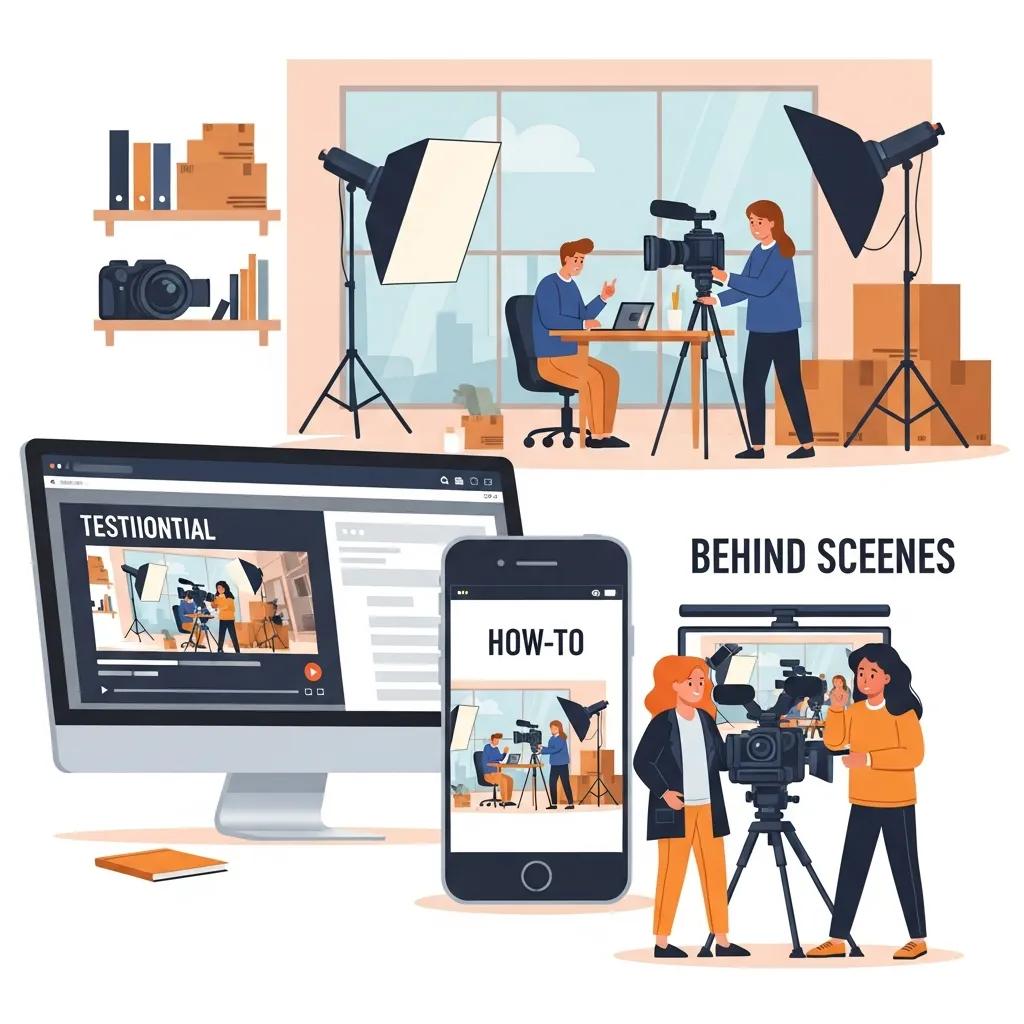
High-impact video strategies for moving companies include testimonial videos, how-to tutorials, behind-the-scenes (BTS) storytelling, local/destination spotlights, and short-form social clips that target awareness through conversion. Each format serves a distinct role: testimonials build trust for decision-stage prospects, how-to videos educate and reduce friction, BTS humanizes the brand, destination videos capture local intent, and short-form social drives discovery and remarketing performance. Below are practical tips for producing and distributing these formats, priorities for the buyer journey, and low-cost scaling tactics that preserve quality while improving lead attribution.
Testimonial videos convert by showing real customers describing specific outcomes, increasing credibility for service-based local searches. How-to moving videos reduce buyer anxiety by demonstrating packing techniques and specialty-item handling, which shortens the sales cycle by answering common objections. Behind-the-scenes content highlights company culture and process transparency to differentiate your brand against competitors who only list prices. Destination and local videos align content with geo-intent and feed local landing pages to improve discoverability in searches and AI recommendations.
The next section breaks down testimonial mechanics and practical production points to maximize conversion impact.
How Do Testimonial Videos Build Trust and Increase Leads?
Testimonial videos work by combining social proof, narrative specifics, and visual evidence to reduce perceived risk and increase conversion likelihood for prospective customers. Record short, structured interviews that focus on the problem, how your team solved it, concrete results (time saved, damage-free move), and a clear recommendation; this narrative arc makes statements credible and easy to reuse in ads and landing pages.
Use natural lighting, short B-roll clips of the move, and on-screen lower-thirds that highlight the customer’s name and neighborhood to increase authenticity and local relevance.
Distribute testimonials across YouTube, service landing pages, and Google Business Profile video uploads, and repurpose 15–30 second excerpts as paid social ads to amplify reach and attribution.
Testimonial KPIs should include view-through rate, engagement rate, and lead conversion attributed to the video; tracking these metrics helps decide which testimonials to promote aggressively.
To capture usable testimonials at scale, include a short post-move request script and offer simple incentives for recorded permission, then batch-edit clips into several formats for channel-specific use.
What Role Do How-To Moving Videos Play in Educating Customers?
How-to moving videos act as educational assets that reduce friction by answering frequent pre-move questions, demonstrating expertise, and positioning your company as a helpful authority in the buying process.
Create tutorials for topics such as packing fragile items, disassembling furniture, and an apartment move checklist; use clear chapter timestamps and a visible step-by-step overlay to help viewers scan and find relevant segments quickly. Implement schema:HowTo markup on pages that host these videos to increase the chance of rich results and voice-agent answers, and include downloadable checklists to capture leads from engaged viewers. Educative content also increases retention and watch time—signals that help YouTube and AI assistants surface your content for local intent queries.
Prioritize how-to topics based on search intent and common customer questions gathered from calls and GBP messages, then repurpose long-form tutorials into short clips for social distribution to drive discovery and remarketing.
Different video types serve distinct goals and KPIs; the table below compares primary video formats by objective and typical KPI to guide prioritization.
Intro: This table helps movers compare common video types by their main marketing goal and the KPI to measure success.
This comparison clarifies which formats to prioritize depending on whether the mover needs credibility, education, local discovery, or rapid audience growth.
Integrating a strategic production and distribution plan turns these video formats into a predictable lead engine, and Stacked SEO’s approach operationalizes that by combining industry-specific strategy, production templates, and channel-level optimization to scale results.
Video Marketing for Moving Companies: Boost Engagement & Leads
YouTube SEO for movers focuses on aligning metadata, thumbnails, chaptering, and channel organization with local search intent and purchase-stage queries so videos surface for prospects and AI assistants. The core optimization actions are: perform keyword research with geo-modifiers, craft intent-rich titles with the primary keyword placed early, write long-form descriptions that include timestamps and service-area mentions, and use thumbnails that combine clear faces, numbers, or a short trust phrase to improve CTR. Consistent upload cadence, playlists organized by intent (e.g., “Packing Tutorials,” “Customer Stories”), and channel branding boost authority signals and subscriber growth.
Below is a practical metadata checklist to implement immediately.
Intro: The checklist below summarizes a step-by-step YouTube SEO workflow focused on moving companies.
- Title: Place primary local keyword within first 50–60 characters and include service modifier.
- Description: First 1–2 sentences = CTA + key terms; full description 200+ words with timestamps and service-area mentions.
- Tags: Use a mix of seed and long-tail tags; prioritize geo-modifiers and question-based phrases.
- Thumbnails: Use high-contrast images, readable short text (3–5 words), and an expressive face or branded color block.
- Chapters & Timestamps: Break content into logical sections to match search intents and increase session time.
Following this checklist improves discoverability and increases the chance of appearing in AI-generated answers and Google video carousels; next we’ll list keyword and tagging tactics to support the checklist.
Which Keywords and Tags Boost Moving Company Video Rankings?
Effective keywords for movers combine service intent with location modifiers and problem-specific long tails, which help rank for both local searches and how-to queries. Seed examples include “movers near me,” “local movers [city],” and “how to pack a TV for moving”; long-tail variants expand to “how to pack kitchenware for moving apartment” or “best moving company for piano in [city]”.
Tags should reflect the primary title keyword, close variations, and an intent-based question; use no more than 12–15 focused tags and avoid tag stuffing. Use chapters and timestamp labels that mirror common search phrases—this helps YouTube and voice agents match subqueries to the exact moment in your video.
Track keyword performance by impressions, click-through rate, and search appearance data in YouTube Studio to iterate title/tag pairs and adjust thumbnails for higher CTR.
What Are Effective Channel Growth Strategies for Movers on YouTube?
Channel growth for movers depends on content pillars, predictable cadence, cross-channel promotion, and conversion-focused assets such as playlists and end screens. Build three content pillars—Education (how-to), Trust (testimonials/BTS), and Local Discovery (neighborhood guides)—and publish on a fixed cadence (e.g., one long-form tutorial + two short clips per week) to create a reliable algorithmic signal. Use playlists to increase session time, collaborate with local businesses or real estate agents for cross-promotion, and run targeted YouTube ad campaigns using testimonial snippets to drive traffic to service landing pages.
A 90-day content blueprint pairs pillar topics with distribution actions—this structure improves watch time and subscriber growth, which then supports higher-ranking potential for commercial queries and local search intent.
The following table lists metadata elements and recommended best-practice values to implement across uploads.
Intro: Use this table as a quick reference for video metadata fields and recommended formats.
Implementing these metadata standards increases the chance YouTube and Google surface your videos for high-intent local queries and helps AI assistants return accurate, useful answers.
Stacked SEO’s YouTube SEO and LLM optimization capabilities can be used by movers who want scalable metadata automation and channel-level optimization executed by specialists familiar with the moving vertical.
What Are Creative Moving Company Video Ideas to Enhance Engagement?
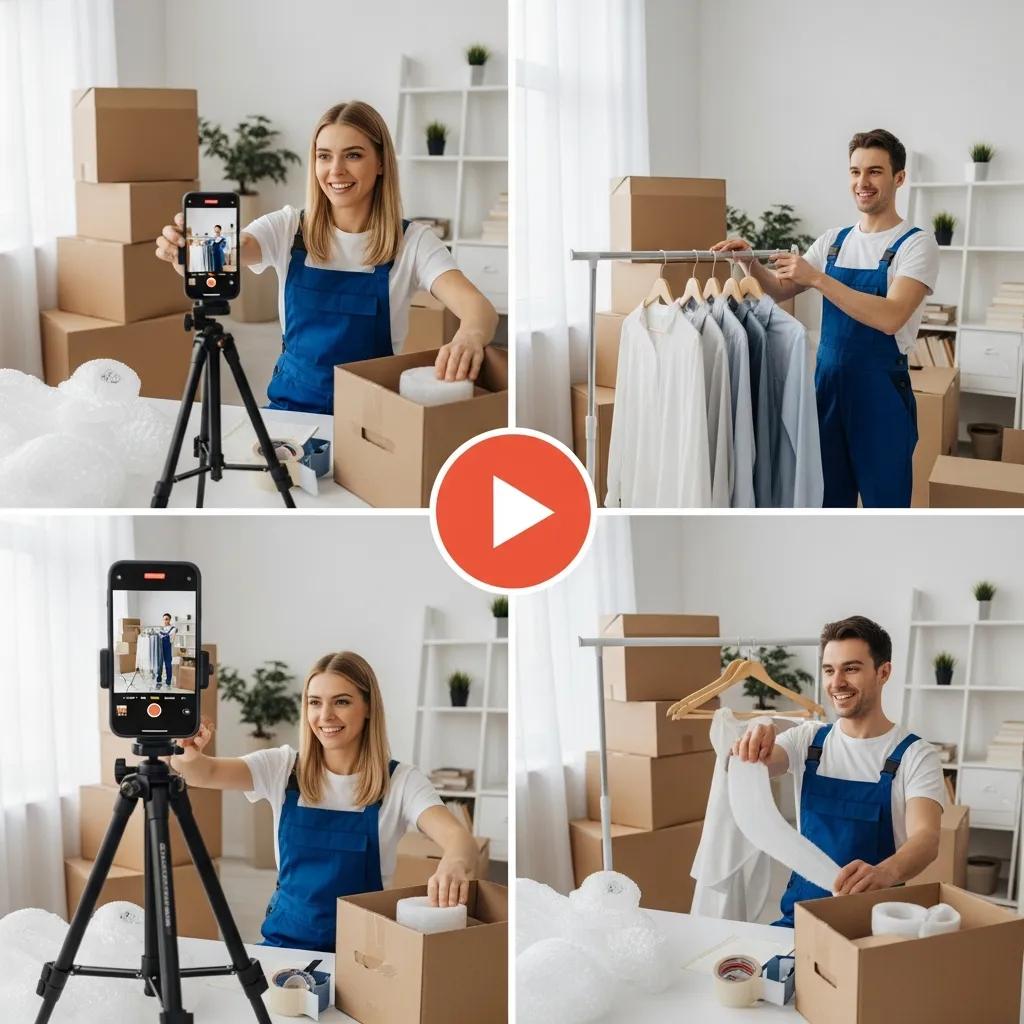
Creative video concepts help moving companies stand out and provide content that’s both helpful and shareable, which increases organic reach and local relevance.
Ideas range from “before-and-after” packing transformations and time-lapse move builds to neighborhood walkthroughs and short team profiles. Repurposing longer tutorials into 15–60 second reels or TikToks multiplies reach while reinforcing brand voice across channels. When planning creative shoots, focus on narrative hooks—show the pain point in the first 3–5 seconds, offer a clear how-to or proof point, and end with a simple CTA that leads viewers to a booking landing page.
The list below offers runnable creative formats with quick production tips suitable for small teams.
Intro: These creative video ideas are optimized for easy production and high engagement.
- Quick packing hacks: 30–60 second clips demonstrating single-item tips.
- Day-in-the-life (BTS): Short sequences showing actual moves and team interactions.
- Neighborhood spotlight: 60–120 second local guides highlighting moving considerations.
- Before-and-after transformations: Time-lapse of packing/loading/unloading.
Each idea can be produced with a smartphone and basic stabilization, then edited into short and long versions for YouTube and social platforms.
How Do Behind-the-Scenes Videos Humanize Moving Brands?
Behind-the-scenes videos humanize moving companies by revealing people, processes, and values that build empathy and trust for prospective customers. Shot lists should include team intros, staging and loading workflows, equipment checks, and small moments that show care (wrapping a fragile item, smiling interactions), with candid audio and natural sound to enhance authenticity. Story-driven BTS that highlights problem-solving on the job (e.g., handling a tricky staircase) demonstrates capability and reduces perceived risk, which supports higher conversion rates. Promote BTS on social channels and embed them on service pages to show real-world competence and connect emotionally with local audiences.
BTS content also feeds short-form ads and remarketing creative, creating a library of authentic touchpoints potential customers can see across platforms.
How Can Destination and Local Videos Attract Nearby Customers?
Destination and local videos attract nearby customers by aligning content with neighborhood-specific searches and by demonstrating local knowledge that AI assistants and local searchers prefer. Produce short neighborhood guides covering parking, building access tips, common elevator restrictions, and local landmarks—these answer local questions and reduce friction for moves in specific areas. Geo-tag videos, include neighborhood names in titles and descriptions, and embed the videos on corresponding local landing pages to maximize local SEO benefits. Use CTAs that invite viewers to request a local quote or view a neighborhood-specific moving checklist to capture intent.
Local videos also serve partner marketing opportunities with realtors and community groups, extending reach to high-intent prospects who value local expertise.
The table below maps creative concepts to production focus and expected impact to help prioritize ideas.
Choosing formats that match your resources ensures consistent content output and measurable engagement improvements.
How Does AI Enhance Moving Company Video Marketing and Content Strategy?
AI enhances video marketing by accelerating ideation, generating scripts, automating editing tasks like captions and thumbnail variants, and analyzing performance to reveal optimization opportunities. Practical AI workflows include prompt-driven script generation for how-to videos, automatic transcription and captioning for accessibility and SEO, thumbnail A/B testing with variant scoring, and AI-driven metadata suggestions aligned to LLM ranking signals. These improvements shorten production cycles, reduce per-video cost, and surface high-performing creative elements faster than manual testing alone.
The next subsections list tools and show how performance analysis feeds iterative improvements in lead generation.
Which AI Tools Help Create and Optimize Video Content Efficiently?
AI tool categories for video production include script generation, automated editing/transcription, thumbnail and creative optimization, and metadata/SEO suggestion engines. For example, prompt-driven models generate draft scripts and shot lists that production teams can refine; automated editors produce caption files and basic cuts from raw footage; and analysis tools recommend title and description variants optimized for both YouTube and LLMs. Integrate tools into a repeatable workflow—idea → AI script → shoot → AI-assisted edit/transcribe → human polish → publish—to scale output while maintaining brand consistency. Each tool category speeds a part of production but requires human review to retain authenticity and local relevance.
Using AI to optimize repetitive tasks frees creative time to focus on storytelling that resonates with moving customers.
Intro: The table below matches AI tool categories to tasks and typical outcomes.
How Can AI Analyze Video Performance to Improve Lead Generation?
AI analyzes video performance by processing watch time patterns, retention curves, CTR by thumbnail/message, and conversion paths to identify creative winners and optimization opportunities. By feeding these signals into a model, AI can recommend title tweaks, thumbnail changes, and ideal chapter points that align content with searcher intent. Combine video analytics with CRM data to attribute leads to video assets—AI can highlight which videos generate calls, form submits, or booking completions and suggest reallocation of budget to the highest-performing creatives. A closed-loop workflow—publish, analyze, iterate—enables continuous improvement in view-to-lead conversion rates.
Linking video performance to lead metrics is essential for justifying spend and optimizing future creative toward measurable bookings.
Stacked SEO leverages AI-driven automation and LLM optimization as part of its All-in-One Growth Engine, applying industry-specific models to scale metadata optimization, tagging strategies, and automated reporting for moving companies seeking faster visibility and measurable lead outcomes.
What Is the Impact of Video Marketing on Engagement and Lead Generation for Movers?
Video marketing materially increases engagement and lead generation for local services by improving metrics that both humans and AI rely on—watch time, CTR, and engagement signals that translate into more impressions and higher ranking potential. Recent industry studies indicate that video can increase conversion intent and recall while boosting click-through rates compared to static listings; for movers, this often translates to higher booked move rates from pages and ads that include video. Benchmarks vary by market, but measuring view-to-lead and view-to-call ratios helps set realistic targets and align budgets to expected outcomes.
The next H3 provides headline statistics and implications for budgeting and testing.
What Are Key Statistics Demonstrating Video ROI in the Moving Industry?
Recent research shows that video increases purchase consideration across service categories, with video viewers more likely to contact a business after viewing relevant content and short-form social clips generating strong top-of-funnel engagement. For local services, case benchmarks often show measurable uplifts in call volume and form submissions when video is present on landing pages and GBP listings. Interpreting these stats requires local A/B testing, but movers can target specific KPIs such as a view-to-call conversion rate improvement of several percentage points and a measurable reduction in cost-per-lead when combining organic video and paid promotions. Use these benchmarks to justify testing budgets and to set iterative targets for improved ROI.
Next we’ll explain how user-generated content (UGC) further reinforces credibility and reach.
How Does User-Generated Video Content Boost Credibility and Engagement?
User-generated video content (UGC) boosts credibility by providing authentic, peer-sourced evidence of service quality and by supplying ready-made creative for ads and landing pages. Encourage UGC through post-move requests, simple submission processes, and incentives like discount codes or entry into a local giveaway; short clips of customers unpacking or praising punctuality are especially persuasive. Moderate submissions for quality, then repurpose high-performing clips into testimonial ads and social stories to improve ad relevance and lower creative costs. UGC also supports social proof within remarketing campaigns, lifting conversion rates by showing real customers in similar neighborhoods.
A structured UGC collection and moderation process builds a pipeline of authentic creative that complements professionally produced assets.
Below is a table summarizing expected engagement and lead metrics influenced by different video tactics.
How Can Moving Companies Integrate Video Marketing with SEO, PPC, and Automation?
Integrating video with SEO, PPC, and automation creates a multi-channel funnel that captures search intent, nurtures prospects, and routes qualified leads to booking systems or voice agents. Place videos on service and local landing pages to increase dwell time and support schema:VideoObject markup; use video thumbnails and clips in PPC landing experiences to increase conversions; and automate distribution to social platforms with scheduled posts and A/B-tested creative. Additionally, feed video insights to lead routing workflows so high-intent video viewers trigger priority follow-up via chat, SMS, or AI voice agents, improving response time and conversion probability.
Below are practical steps for embedding video into multi-channel campaigns.
Intro: This checklist outlines how to operationalize cross-channel video integration.
- Embed video on service and local landing pages and add schema:VideoObject metadata.
- Use short testimonial clips in YouTube and social PPC campaigns with location targeting.
- Automate posting and reporting to track video-driven leads across channels.
- Route qualified video leads to priority follow-up workflows (chat/voice agents/CRM).
What Are Best Practices for Combining Video with Local SEO and Google Business Profiles?
To combine video with local SEO effectively, embed service-specific videos on relevant landing pages, include location keywords in titles and descriptions, and upload short clips to Google Business Profile with concise, location-focused captions. Implement schema:VideoObject on pages hosting video to help search engines index and display rich results, and include transcripts to capture long-tail queries. Measure local impact by tracking impressions from local search, GBP interactions, and form submissions from pages that contain video. Proper placement and metadata ensure videos assist both ranking and direct conversion on local searches.
Embedding videos and using structured data makes it easier for AI assistants and local search features to surface your content to nearby prospects.
How Do AI Voice Agents and PPC Campaigns Amplify Video Marketing Results?
AI voice agents and PPC campaigns amplify video marketing by turning passive viewers into active leads through immediate, automated follow-up and targeted paid amplification. PPC campaigns use testimonial and how-to video assets to lower cost-per-click and increase ad relevance; AI voice agents can answer move-specific questions using video transcripts and route high-intent callers to human schedulers or capture appointments directly. Cross-channel attribution is critical—track which video asset drove the initial interaction and feed that into CRM for accurate lifetime value calculations. The combination of paid reach and automated response reduces lead leakage and shortens time-to-booking.
Testing creative across paid and organic channels, then routing responses through automation, creates a predictable pipeline from view to booked move.
Stacked SEO’s All-in-One Growth Engine integrates SEO, PPC, AI, and automation to help moving companies operationalize these integration steps; its industry specialization and automation capabilities support scalable execution and measurable lead results while offering assurance through a Profit or Free Guarantee for qualifying outcomes.
- Prioritize high-impact formats: Testimonials and how-to videos improve conversion and reduce friction.
- Optimize metadata and thumbnails: Small changes in titles and thumbnails yield measurable CTR gains.
- Use AI to scale: Automate captions, thumbnails, and metadata suggestions to increase output without losing local relevance.
- Integrate channels: Embed videos on local pages, run paid campaigns with video creative, and automate lead routing to ensure rapid follow-up.
These combined tactics help ensure videos consistently drive higher engagement and measurable lead growth for moving companies.