

Boost Moving Company Leads with AI Voice Agents
AI voice solutions combine natural language understanding, speech-to-text transcription, and automated decision logic to handle inbound and outbound calls, instantly matching intent to the right sales outcome and reducing missed opportunities. This guide explains how AI voice agents convert inquiries into qualified moving leads, speed booking, and integrate with sales workflows to boost conversion and revenue for moving companies. Many moving businesses lose potential customers due to slow response times, missed calls, and inconsistent quoting; AI voice agents solve those problems by providing instant qualification, 24/7 outreach, and CRM-aware routing. Readers will learn the mechanics behind voice agents, the key features that matter for movers, CRM integration best practices, ROI calculations, implementation challenges and mitigations, and emerging LLM-driven trends that shape visibility and lead performance. Throughout the article, targeted keywords like voice agent lead generation, AI customer interaction moving, and CRM integration AI voice are woven into practical tactics and examples to help operations and marketing teams prioritize automation investments.
What Are AI Voice Agents and How Do They Transform Moving Company Lead Generation?
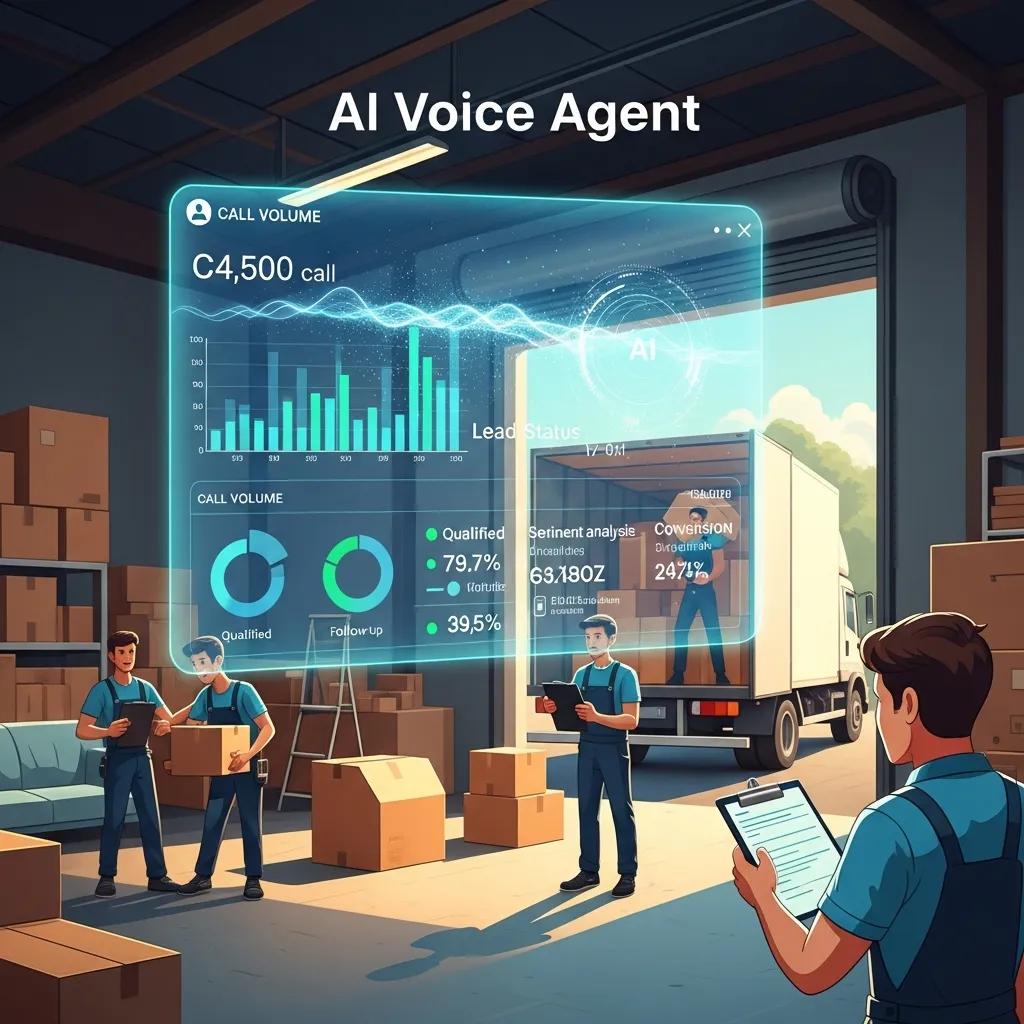
AI voice agents are conversational AI systems that answer calls, interpret intent, and perform structured qualification to turn casual inquiries into bookable moving leads. They work by converting speech to text, applying natural language understanding to identify move size, timing, and service type, and then triggering rules or live transfers that maximize contact and booking rates. The immediate mechanism—instant response plus qualification—reduces lead decay and increases contact rates because prospects receive accurate, timely information when they are actively comparing options. This capability directly improves conversion metrics for moving companies by recovering missed calls and handling overflow, which conventional approaches often fail to address.
Stacked SEO’s All-In-One Growth Engine includes an AI Voice Agent example that integrates conversational qualification, missed-call recovery, and CRM automation as part of a combined SEO, PPC, and AI stack. This brief example illustrates how a vendor-led voice agent can be deployed alongside organic and paid channels to close more calls; it is provided as a contextual model rather than an exhaustive product description. The following sections unpack how qualification works and which features matter most for moving operators so teams can evaluate solutions on technical fit and business impact.
AI voice agents use structured qualification flows to prioritize leads based on intent signals and business rules. Below is a compact list explaining core components and how they translate to higher lead capture.
- Intent Detection: Interprets caller needs like local move, long-distance move, or storage inquiries.
- Qualification Prompts: Asks key questions about inventory, date, and access to estimate effort.
- Routing Rules: Prioritizes and routes high-intent calls to sales reps or books appointments automatically.
These components form a repeatable workflow that reduces response time and funnels high-intent prospects to immediate next steps. Understanding these mechanisms prepares a mover to define qualification rules and handoff points that match their sales capacity.
How Do AI Voice Agents Qualify and Prioritize Moving Leads Instantly?
AI voice agents qualify leads by asking a scripted set of high-value questions—move date, origin and destination, approximate inventory, and access constraints—and then scoring responses against predefined thresholds. The scoring logic assigns priority tiers so agents route hot leads to live closers immediately while placing lower-tier leads into nurture sequences or automated follow-up. Qualification paths often include branching when callers provide ambiguous answers, with fallbacks to gather missing data or schedule a human callback. This rapid triage shortens time-to-contact, and because qualification is consistent, sales teams receive higher-quality leads with clearer next actions.
A typical decision-tree begins with intent identification, proceeds to capacity-relevant questions, and ends with either a live-transfer, a quoted estimate, or an appointment booking. That logic can be tuned to local pricing and agent availability so high-value moves (e.g., multi-bedroom or long-distance jobs) get priority. Teams should monitor false-positive and false-negative rates in their scoring to refine thresholds and improve transfer accuracy over time.
What Features Make AI Voice Agents Essential for Moving Businesses?
The essential features of AI voice agents combine conversational capability with operational integrations to capture, qualify, and convert moving inquiries reliably. In practice, movers need round-the-clock availability, automated quote generation, appointment scheduling, CRM synchronization, and objection-handling scripts that mirror top-performing human reps. When these features are orchestrated together, agents increase contact rates, reduce administrative load, and deliver consistent pre-sale information that shortens decision timelines for prospective customers.
Below is a comparison table showing common features, their primary benefit, and a concrete impact on lead capture to help prioritize procurement and implementation choices.
This comparison highlights how each component maps directly to operational gains: availability increases capture, quoting accelerates decisions, scheduling turns prospects into appointments, and CRM sync preserves data quality for sales.
A summary: prioritize features that reduce friction at first contact, enable immediate next steps, and feed structured data into CRM workflows to maximize the value of captured leads.
How Does Automated Customer Service Improve Booking and Customer Experience for Movers?

Automated customer service using AI voice agents improves booking rates and customer experience by delivering quick, consistent responses and reducing manual scheduling errors. By handling routine inquiries and providing instant estimates or booking windows, automation shortens the buyer journey and removes common friction points such as delayed callbacks or conflicting calendar entries. Customers experience a predictable interaction whether they call at midday or midnight, which strengthens trust and increases the likelihood of choosing a provider that responds promptly and clearly. Operationally, automation frees staff from repetitive tasks so human agents can focus on closing and complex problem solving, improving overall service quality.
A list below outlines key service improvements that automated customer service delivers for moving companies, formatted to illustrate practical capabilities and typical outcomes.
- 24/7 First Response: Answers and qualifies incoming calls at any hour to keep prospects engaged.
- Fast Quote Delivery: Uses predefined rate tables and variables to provide immediate estimates.
- Consistent FAQ Handling: Delivers standardized answers that reduce buyer confusion and support brand consistency.
After implementing these capabilities, movers typically see a reduction in missed opportunities and improved customer satisfaction scores. The next two subsections explain how nonstop quoting works technically and how agents manage FAQs and booking flows to minimize manual scheduling work.
How Can AI Voice Solutions Provide 24/7 Support and Quote Generation?
AI voice solutions enable 24/7 support and basic quote generation by combining structured inputs with configurable pricing models and fallback rules. The agent asks for address details, inventory cues (e.g., number of rooms, large items), and access constraints, then consults rate tables or pricing algorithms to produce a preliminary quote range. For complex scenarios, the voice agent escalates to a human estimator or schedules a virtual survey, ensuring accuracy while still engaging the caller. The technical foundation requires accurate rate tables, variables for access/time windows, and a decision engine that maps answers to estimate bands.
A concise workflow list below shows a typical quote generation path useful for snippet-style answers:
- Collect Key Inputs: Address, move date, inventory estimate, access notes.
- Consult Pricing Rules: Apply time, distance, and labor multipliers to compute a range.
- Deliver Quote or Escalate: Provide an immediate estimate or schedule a human follow-up.
This workflow speeds decision-making for customers and reduces friction by giving prospects actionable information immediately, improving the chance they will book rather than shop further.
What Role Do AI Voice Agents Play in Managing FAQs and Appointment Scheduling?
AI voice agents handle FAQ responses and appointment scheduling by combining a knowledge base with calendar integrations and automated confirmation messages. Agents can answer routine queries—insurance options, packing guidance, arrival windows—and when callers request appointments, the agent checks availability, reserves slots, and sends confirmations while updating the CRM. This reduces administrative burden and ensures booking data is captured accurately at first contact. The system also supports rescheduling and reminders that cut no-shows, enhancing the overall customer experience.
To illustrate practical savings, teams often report fewer scheduling conflicts and lower admin time per booking after deploying voice agents, because confirmations and reminders are automated. Maintaining an up-to-date calendar sync and a clearly authored FAQ knowledge base ensures the agent’s responses remain accurate and helpful.
How Do AI Voice Agents Integrate with Moving Company CRMs to Streamline Sales Processes?
AI voice agents integrate with CRMs by creating and updating lead records, attaching call transcripts and post-call summaries, and triggering follow-up automation based on intent and outcomes. Integration touchpoints typically include lead creation on first contact, contact enrichment from caller responses, appointment events pushed to calendar objects, and task creation for human follow-up. These automated data flows reduce manual entry, preserve context for sales reps, and allow for immediate nurture sequences tailored to lead priority. Proper integration ensures the voice agent complements existing sales processes instead of fragmenting them.
Below is a practical checklist that outlines best-practice integration steps to ensure smooth data flow and operational reliability during deployment.
- Map Fields: Align voice agent outputs to CRM lead/contact fields with canonical formats.
- Configure Webhooks/APIs: Use secure, authenticated endpoints for real-time event delivery.
- Test End-to-End: Run scenarios for hot-transfer, quote-only, and nurture paths to validate logic.
Completing these steps reduces synchronization errors and helps teams measure lead-to-booking velocity accurately; next we show a detailed EAV-style mapping that clarifies common CRM automation results.
What Are the Best Practices for Seamless CRM Integration with AI Voice Agents?
An integration table below shows common CRM capabilities, required integration steps, and the resulting automation outcomes to guide technical planning and stakeholder alignment.
This mapping clarifies how each integration point yields a concrete automation that reduces manual work and increases conversion reliability. Teams should prioritize the highest-impact mappings first—lead creation, appointment sync, and post-call notes—before layering more complex automations.
After mapping, perform staged rollouts with clear test cases to catch field mismatches, latency issues, and permission errors. Iterative testing with real call samples improves data integrity and adoption readiness.
How Does AI Enhance Post-Call Summaries and Workflow Automation?
AI improves post-call summaries by extracting intent, capturing quote details, tagging sentiment, and producing concise next-action items that feed directly into CRM workflows. Automatic summaries typically include caller intent, estimated move size, proposed dates, and recommended follow-ups, which sales teams use to prioritize outreach. When summaries include structured tags—such as “high intent,” “needs survey,” or “requires estimator”—workflows can automatically assign tasks, queue emails, or schedule callbacks. This reduces time spent on manual note-taking and increases salesperson focus on conversion activities.
A sample post-call summary often contains the quote range, key constraints, and a recommended next step that triggers an automation, such as sending a confirmation or assigning a live transfer to a senior estimator. Over time, these automated triggers shorten response cycles and increase the proportion of leads that receive timely human attention.
What Is the ROI of AI Voice Solutions for Moving Companies?
Estimating ROI for AI voice solutions combines measurable improvements in contact rate, conversion rate, average revenue per booked move, and operational cost reductions. Typical ROI drivers include faster response time (which increases conversion), recovered missed calls, reduced human headcount or reallocation of staff to higher-value tasks, and higher close rates from improved lead qualification. A simple ROI model projects incremental booked moves from improved contact and conversion, multiplied by average move revenue, minus platform and integration costs to estimate payback periods and ongoing profitability.
The table below provides compact ROI metrics to compare before/after expectations for common KPIs so decision-makers can approximate improvements during vendor evaluation.
These ranges represent conservative to optimistic scenarios depending on baseline performance and implementation quality. To compute ROI, multiply additional booked moves by the average revenue per move and subtract combined platform plus labor savings; this yields net gain and payback estimates.
Stacked SEO positions its All-In-One Growth Engine with a Profit or Free Guarantee that promises a minimum booking outcome — a demonstration of vendor confidence designed to reduce adoption risk for moving companies. This guarantee frames the commercial value proposition and can be used as a negotiation point when assessing supplier ROI, but teams should validate assumptions with their own baseline metrics and pilot data before scaling.
How Do AI Voice Agents Increase Conversion Rates and Revenue Growth?
AI voice agents increase conversion rates by shrinking the time between inquiry and response, ensuring consistent qualification, and routing high-value prospects to human closers immediately. Faster responses reduce lead decay and increase the probability a prospect will book rather than seek alternatives. When agents provide quick quotes and easy scheduling, prospects are more likely to commit; combined with prioritized follow-ups and automated reminders, conversion velocity increases and revenue grows. Modeling these effects requires baseline call volume, average revenue per move, and expected uplift percentages, which together yield monthly revenue projections.
A short calculation example: if a mover averages 300 inbound leads and voice agents recover 20% of previously missed calls with a 15% conversion uplift on those recovered leads, the additional booked moves multiplied by average move revenue demonstrates clear incremental revenue that often pays back implementation costs within months.
What Case Studies Demonstrate Success with AI Voice Solutions in Moving?
Short, anonymized case summaries typically show before/after metrics such as calls answered, booked moves, and conversion rate improvements within a three-month window after deployment. Representative snippets often highlight a rapid reduction in missed calls, improved booking velocity, and tangible increases in monthly booked moves following voice-agent integration and CRM automation. Implementation timelines generally range from pilot (2–4 weeks) to full rollout (6–12 weeks) depending on integration complexity and training needs.
Key takeaways from successful cases emphasize careful qualification rule design, tight CRM mappings, and iterative script tuning to match local pricing and customer language. These operational measures often produce the largest performance gains, reinforcing that technology must be combined with business-process configuration to realize full ROI.
What Challenges Do Moving Companies Face When Implementing AI Voice Technology and How Can They Overcome Them?
Moving companies commonly face technical, training, and trust challenges when adopting AI voice agents; these include ensuring natural-sounding interactions, building representative training datasets for industry terms, and securing staff buy-in for automated workflows. Technical hurdles often involve integrating with legacy CRMs and ensuring data consistency, while human concerns center on whether AI can handle nuanced objections and maintain a brand voice. Overcoming these issues requires a phased rollout, ample real-call training data, and stakeholder involvement to align agent scripts with sales playbooks.
Below is a mitigation-focused list that outlines common challenges and practical actions teams can take to reduce deployment friction.
- Naturalness and Voice Persona: Use voice tuning and script customization to match brand tone and reduce awkward phrasing.
- Industry Training Data: Collect representative call samples for domain-specific training and iterate scripts based on edge cases.
- Change Management: Involve sales and operations early, run pilots, and present measured gains to build trust.
These steps lower perceived risk and improve adoption rates, enabling companies to move from pilot to full-scale implementation with confidence.
How to Address Concerns About AI Voice Naturalness and Industry-Specific Training?
Addressing naturalness requires deliberate voice persona design, script refinement, and domain-specific training that captures the jargon and common scenarios of moving customers. Tuning steps include recording exemplar human calls, annotating intents and entities, running A/B tests of voice variants, and iterating on fallback strategies to minimize repeated clarifications. Quality testing protocols should include live-call shadowing and manual review of transcripts to catch misclassifications and ensure the agent understands pricing and access terms accurately. Over time, continuous learning from real interactions refines the model and increases perceived naturalness.
A practical approach pairs recorded human calls with synthetic augmentation for rare scenarios and uses progressive exposure: start with simple flows, then expand to handle more complex quoting and objections as confidence grows. This staged strategy reduces risk and improves early performance metrics.
What Measures Ensure Data Privacy and Security in AI Voice Solutions?
Data privacy and security are ensured by implementing encryption for data-in-transit and data-at-rest, strict access controls, clear retention policies, and documented consent practices for recording calls. Vendors should offer contractual protections and evidence of security practices; teams must also ensure CRMs enforce role-based access and that sensitive data elements are masked where appropriate. Regular audits, secure API keys, and logging of integration events further reduce exposure and provide traceability for compliance purposes.
A compliance checklist includes encrypted storage of call audio and transcripts, retention limits aligned with policy, explicit caller consent prompts, and vendor security questionnaires to validate controls. These measures protect customer data while enabling the operational benefits of voice automation.
What Are the Future Trends in AI and LLM Optimization for Moving Company Lead Generation?
Future trends point to tighter integration between voice agents and large language models (LLMs), enabling richer pre-call engagement, smarter summarization, and improved AI visibility in multi-channel discovery. LLM optimization will make voice agents better at understanding nuanced intent and generating more context-aware responses, while generative AI will enable dynamic pre-call content—like tailored FAQs or messaging—that improves conversion. The convergence of voice, LLMs, and CRM data will create end-to-end experiences where prospects are engaged proactively across voice, chat, and SMS with coherent context and faster resolution.
Below are two concise trend bullets that capture near-term practical directions for movers:
- LLM-Driven Visibility: Optimizing structured content and entity signals increases chances of being surfaced by AI assistants during multi-modal searches.
- Cross-Channel AI Orchestration: Combining voice agents with chat and SMS enables personalized, context-rich follow-ups that improve booking rates.
These trends suggest experiments such as entity-first FAQ optimization and pilot cross-channel workflows to measure uplift. For teams ready to advance, combining voice automation with LLM-aware content strategies will be a high-impact priority in the coming year.
Practical next steps: vendors that bundle AI voice with broader acquisition tools simplify adoption. Stacked SEO’s All-In-One Growth Engine exemplifies this direction by combining LLM optimization, PPC, SEO, and an AI Voice Agent so movers can align discovery and call-handling under one program. For companies evaluating pilots, consider vendor guarantees and proof points, and request a short demo to validate integration pathways and expected uplift.
For teams ready to act, a discovery conversation or demo of an integrated All-In-One Growth Engine that pairs LLM optimization with AI voice demonstrates potential lead and booking improvements and clarifies implementation effort.