
AI-Driven Marketing Automation & Lead Generation for Moving Companies
AI marketing for moving companies combines artificial intelligence, automation, and data-driven tactics to capture, qualify, and convert local moving leads with minimal manual effort. At its core, this approach uses conversational agents, voice automation, predictive scoring, and LLM-aware content to reduce response time, improve lead quality, and lower cost-per-lead. Readers will learn the tactical funnel—how AI captures leads via chat and voice, scores intent, nurtures prospects, and optimizes discovery through LLM and voice-search techniques—so teams can implement pilots that deliver measurable lift. This guide maps the technology stack, essential tools, and operational best practices for movers, and it includes practical examples, comparison tables, and checklists for starting a pilot in the current market (April 2024). Throughout the article you’ll find recommended evaluation criteria, EAV-style comparison tables, and selective examples of an All-In-One Growth Engine that integrates SEO, PPC, chat, and AI voice to illustrate vendor possibilities without replacing your evaluation process.
Why Is AI a Game-Changer for Moving Company Marketing?
AI marketing automates repetitive outreach and applies machine learning to prioritize high-intent leads, which reduces manual workload and increases conversion rates. Mechanically, AI analyzes signals—query language, move date, inventory size, and local intent—to route prospects to the right channel and message, producing faster response times and higher booking velocity. The result is measurable: faster lead capture, improved conversion, and more efficient ad spend through automated optimization. Below are the primary benefits that make AI transformational for movers and local service operators.
- Faster lead response: Automated chat and voice reduce initial response time to seconds, preserving intent and reducing lead decay.
- Higher lead quality: Predictive scoring focuses sales effort on high-value prospects, cutting wasted time.
- Lower acquisition cost: AI-driven bidding and audience segmentation optimize PPC and local campaigns to reduce CPC and CPA.
How Does AI Overcome Common Moving Industry Marketing Challenges?
Moving companies face seasonality, high CPCs, manual call handling, and trust-building challenges; AI provides targeted solutions for each. For seasonality, demand forecasting models smooth spend and identify off-peak micro-audiences to engage earlier, which improves utilization and reduces idle capacity. For high CPCs and wasted ad spend, automated bid strategies and intent filters allocate budget to terms and audiences most likely to convert, lowering CPA. Finally, AI-powered chat and voice agents capture callers and web visitors 24/7, ensuring fewer missed opportunities and a consistent initial experience that supports review generation and trust. These operational improvements translate into clearer sales pipelines and faster scaling for motivated teams.
What Competitive Advantages Do Moving Companies Gain from AI Adoption?
Adopting AI shifts a mover from reactive to proactive marketing, enabling differentiation through speed, personalization, and measurable ROI. Companies using AI gain agility—testing offers and adjusting routes quickly—while smaller, specialized teams can compete with larger incumbents by automating repetitive tasks. Predictive scoring increases lead-to-booking ratios by ensuring sales focus is on high-likelihood prospects, and consistent chat/voice interactions improve reputation signals that feed into higher local visibility. That competitive edge shortens the time-to-value for marketing investments and positions a mover for scalable growth as local demand fluctuates.
How Do Moving Companies Use AI for Lead Generation Automation?
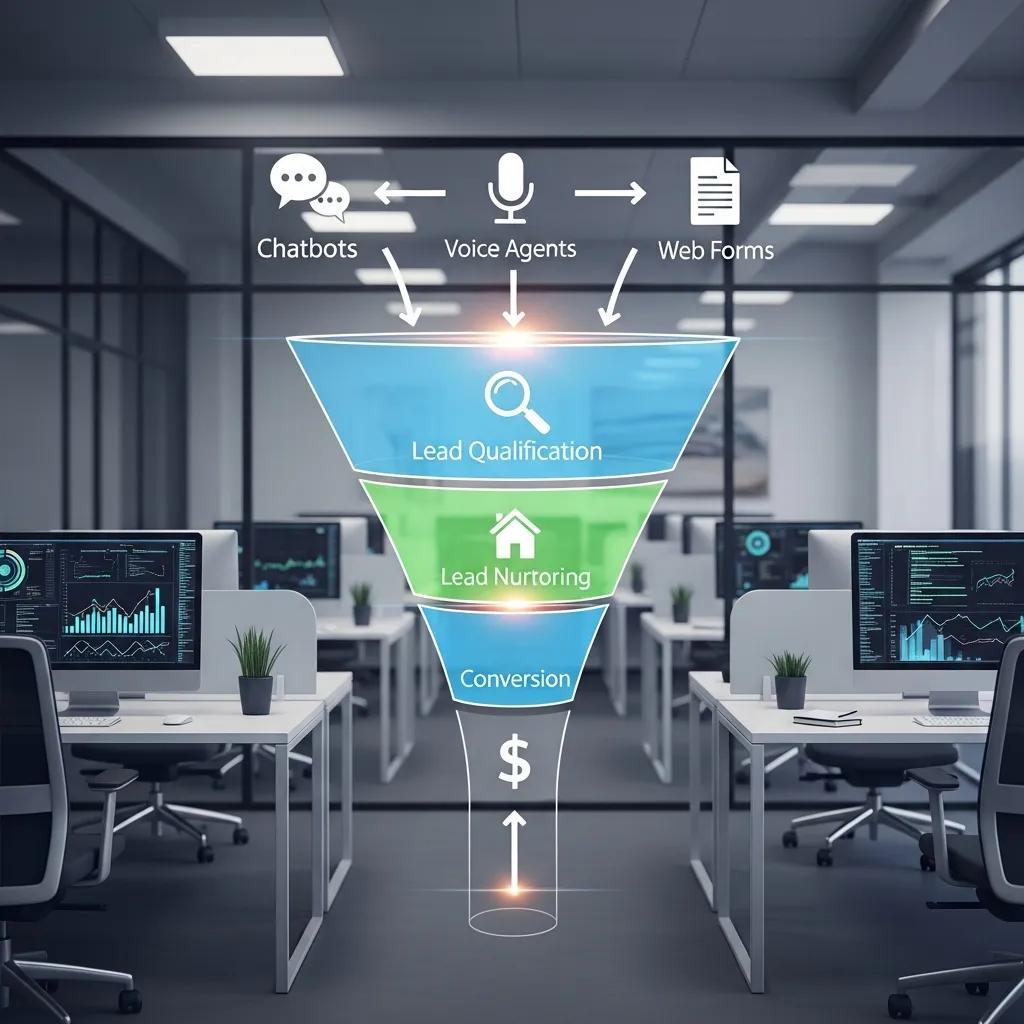
Lead generation automation for movers is a funnel: capture prospects across channels, score intent with models, nurture via automated sequences, and convert with optimized handoffs. Practically, moving companies deploy chatbots to capture web traffic, AI voice agents to answer inbound calls, and web forms enhanced by intent signals to gate bookings, with each touchpoint contributing signals to a central CRM for scoring and routing. The outcome is a predictable flow where qualified leads reach human sales when required and self-serve options close simple bookings.
Introductory note: This table compares common capture channels and how they perform on speed, intent scoring capability, and conversion lift.
- Chat capture: Real-time chat captures casual browsers and converts them through scheduling and estimate flows.
- Voice capture: AI voice agents answer and qualify calls when teams are busy, improving booking rate.
- Form + intent: Smarter forms ask key qualifying questions (move date, inventory) and feed scores to CRM.
After channels and scoring are defined, a key next step is intelligent lead qualification and clear routing rules.
What Is Intelligent Lead Qualification and Scoring for Movers?
Intelligent scoring assigns numeric values to explicit and implicit signals—explicit items like move date or inventory size, and implicit signals like conversational urgency or repeat visits—to compute a readiness score. A sample scoring schema might weight move date within 30 days heavily, inventory size moderately, and conversational language for urgency as a multiplier; leads above a threshold route instantly to sales while lower-scoring leads receive nurturing. This reduces wasted sales time and increases close rates by focusing human attention where it matters most. In practice, lead qualification models are continuously refined using conversion outcomes to improve predictive accuracy.
How Does Automated Lead Nurturing Improve Conversion Rates?
Automated nurture sequences combine AI-personalized messaging across email, SMS, and follow-up calls to stay top-of-mind without manual effort. A typical workflow sends a confirmation, a value-add moving checklist, an automated price-match or discount message, and a final call-to-action to book an estimate, with timing optimized by AI based on engagement signals. A/B testing of subject lines and message cadence—managed by the automation platform—improves open and click-through rates, and personalization (city-specific tips, move-size content) increases conversions. Teams track KPIs like open rate, CTR, and nurture-to-book conversion to iterate sequences and improve ROI.
What Marketing Automation Tools Are Essential for Moving Companies?
Essential tool categories form a tech stack that captures, qualifies, and converts leads: conversational chatbots, AI voice agents, CRM and workflow automation, email/SMS automation, LLM content tools, and local SEO platforms. Each category serves a distinct role—capture, qualification, nurturing, content optimization, and local discovery—and the right architecture ties signals together for unified scoring and reporting. When evaluating tools, movers should prioritize integration complexity, data ownership, and support for local entity signals.
Below is a side-by-side comparison of core tool categories and their practical fit for movers.
- Chatbots: Provide immediate qualification and can schedule estimates without human intervention.
- AI voice agents: Handle peak inbound call volume and route high-value calls to human agents.
- CRM + automation: Centralize scoring and trigger nurture workflows that improve booking rates.
Stacked SEO example: Some specialized vendors now package these capabilities into an All-In-One Growth Engine that integrates full-service SEO and PPC management, AI voice agents for inbound calls, LLM and AI-powered search optimization, Google Business Profile optimization, and content strategy into a unified stack. Using an integrated engine simplifies data flow, reduces integration time, and lets agencies manage end-to-end testing and optimization in a single environment.
How Do AI Chatbots Enhance Customer Engagement on Moving Websites?

AI chatbots extend web presence by answering FAQs, capturing lead details, scheduling estimates, and handing off to voice agents or humans when needed. They reduce missed leads by immediately engaging visitors, and when integrated with CRM they enrich lead records with conversational context that improves subsequent outreach. Typical conversation flows start with a friendly qualifier (“When is your move?”), proceed to inventory estimation, and end with scheduling or a callback, reducing friction in the booking path. Measurable outcomes include reduced response time, higher capture rate, and improved booking velocity when chat scripts are iteratively optimized.
What Are the Benefits of AI Voice Agents for Inbound Calls?
AI voice agents handle volume, qualify callers, and can book or pre-qualify estimates, providing 24/7 coverage and consistent initial experiences that humans can follow up. They transcribe calls, surface intent signals to CRM, and reduce human agent time spent on basic qualification, freeing staff for complex negotiations and upsells. Operationally, voice agents improve call-to-book conversions by capturing callers who would otherwise reach voicemail and by routing high-value prospects immediately to sales. Proper escalation paths and human handoffs preserve CX while maximizing handled-call rates.
How Can Moving Companies Optimize Search Visibility Using AI?
AI improves search visibility by optimizing content for LLMs and voice assistants, automating local citation management, and using entity-based approaches to strengthen local relevance. LLM optimization differs from classic keyword SEO by focusing on entity salience, conversational snippets, and structured prompts that map to how AI search surfaces answers. Implementing these tactics increases discoverability in AI-driven search interfaces and improves performance on traditional SERPs as well.
Below is a comparison of LLM-focused tactics versus traditional SEO outcomes.
- Entity-first content: Create pages and snippets that emphasize local entities, services, and move specifics.
- Schema & GBP completeness: Structure local data so AI engines can extract accurate facts for answers.
- Conversational Q&A: Publish short, answer-style content optimized for voice and AI assistants.
What Is LLM Optimization and Its Role in Moving Company SEO?
LLM optimization means framing content and signals so large language models correctly interpret entities, relationships, and local intent rather than only matching keywords. The mechanism involves prompt engineering for content, explicit entity mentions (service, city, move types), and structured snippets that answer likely questions in a conversational tone. Success is measured by increased visibility in AI answers, improved featured snippets, and higher qualified traffic from voice queries. Teams should measure LLM-aware KPIs like snippet impressions, conversational engagement, and downstream conversions.
How Does Voice Search Optimization Boost Local Moving Leads?
Voice search optimization captures users issuing conversational queries like “who can help me ,” so content must mirror natural language and include move-specific context. Tactics include short answer blocks, local schema, GBP completeness, and mobile-first load speed to ensure voice assistants surface your information. Testing via real-device queries and tracking voice-driven conversions helps validate impact and iterate copy and schema for better placement. Voice optimization funnels highly local, urgent intent to booking paths when paired with fast chat or call routing.
How Does AI Improve Operational Efficiency and Reputation for Movers?
AI links marketing to operations by automating customer service triage, scheduling, and review management, improving both efficiency and brand trust. By handling common inquiries and routing exceptions to humans, AI reduces scheduling friction and operational errors. Automated review solicitation, sentiment analysis, and response drafting also maintain reputation signals that influence local visibility and consumer trust. These improvements shrink administrative burden and create measurable KPIs tied to customer experience.
- Customer triage: AI handles routine issues and escalates complex cases to humans, reducing response time.
- Scheduling automation: Intelligent dispatch integrates with calendars and reduces double-booking.
- Review automation: Solicitation and monitoring improve review volume and quality.
These operational gains feed back into marketing by increasing successful delivery rates and positive signals that search engines and local platforms value.
How Is AI Used in Automated Customer Service for Moving Companies?
Automated customer service uses chatbots and voice agents to triage inquiries, provide status updates, coordinate dispatch, and handle cancellations or rescheduling with clear escalation rules. The mechanism ties conversational events to operational systems so status changes update schedules and notify teams, reducing manual synchronization errors. Example flows include automated arrival-window updates and damage-claim triage; these reduce inbound support calls while improving client visibility into their move. Teams track metrics like average handling time, resolution rate, and customer satisfaction to measure impact.
What Role Does AI-Powered Review Management Play in Building Trust?
AI-powered review management automates solicitation, monitors sentiment across platforms, and drafts context-aware responses to preserve tone and compliance. Automated prompts after successful jobs increase review volume, while sentiment analysis flags negative experiences for rapid remediation before public escalation. Response drafting speeds human review replies and maintains consistent messaging across listings. This approach improves both the quantity and quality of reviews, which strengthens conversion rates and local search authority over time.
What Are the Best Practices for Implementing AI Marketing in Moving Companies?
Start with small, measurable pilots, maintain clean data hygiene, and select vendors that prioritize integration and local entity management. Pilots should target a single high-impact use case—like chat capture + nurture or AI voice for after-hours calls—to validate KPI improvements quickly. Data readiness (CRM completeness, call tagging, tracking) is non-negotiable because AI models need consistent inputs to score and route effectively. Vendor selection criteria should include mover specialization, integration breadth, and outcome guarantees where applicable.
Key checklist before launch:
- Audit data sources: Ensure CRM, call logs, and web analytics are centralized and clean.
- Select a single pilot: Choose a high-impact use case with measurable KPIs and a short timeline.
- Define KPIs & governance: Track response time, lead-to-book rate, CPA, and customer satisfaction.
What Are the Key First Steps to Start AI Marketing Automation?
Begin by auditing lead flows and data, then pick one use case to pilot within 30–60 days with clear metrics and ownership. The ordered checklist: map where leads originate, verify tracking is complete, choose a capture and qualification workflow (e.g., chat + CRM scoring), and set short-cycle tests to measure lift. Establish escalation rules and human-in-the-loop checkpoints to maintain service quality during the pilot. Quick iterations and measurement reduce wasted spend and demonstrate ROI for broader rollouts.
How Can Partnering with an AI-Driven Agency Like Stacked SEO Accelerate Growth?
Partnering with a specialist agency can shorten time-to-value because the vendor brings integrated capabilities and mover-specific experience to execution. Stacked SEO, for example, positions itself as a digital marketing agency specializing exclusively in the moving industry and offers an All-In-One Growth Engine that integrates full-service SEO and PPC management, AI Voice Agent for inbound calls, LLM and AI-powered search optimization, Google Business Profile optimization, local SEO with heatmap tracking, and complete content strategy including LLM-optimized content. For movers evaluating vendors, working with a team that combines industry specialization and integrated tooling can reduce integration overhead and accelerate measurable outcomes. Agencies that offer guarantees or accelerated timelines—such as claims of first-page ranking windows and outcome-based assurances—can also lower perceived risk when aligned to a clear pilot plan and KPIs.
For next steps with a specialized partner: scope a single pilot, define KPIs, confirm data access and ownership, and agree on timelines and reporting cadence so results are transparent and actionable.