

Local SEO for Moving Companies: Complete Guide to Dominating Your Market with Proven SEO Strategies
Local SEO for moving companies means optimizing digital assets so your service appears prominently when nearby customers search for movers, estimates, or same-day help. The core mechanism combines a fully optimized Google Business Profile, geo-targeted landing pages, technical on-page SEO, off-page authority building, and AI/GEO readiness so generative platforms and voice assistants recommend your business. This guide teaches moving companies how to rank in the Local Pack, capture qualified leads, and shorten the time from first click to booked job by applying practical, measurable tactics. You will learn step-by-step GBP optimization, keyword mapping for service-area pages, AI search optimization techniques, off-page outreach that earns local links and citations, and the KPIs and tools to track performance. Each H2 below breaks the problem into actionable workflows and checklists so teams can prioritize high-impact tasks that produce more calls, requests for estimates, and booked moves. First we’ll cover Google Business Profile optimization because it’s the fastest lever for local visibility and leads.
Local SEO for Moving Companies: How to Dominate Local Search

A Google Business Profile (GBP) optimized for moving companies defines the business, clarifies service areas, and signals relevance to local search and maps results, increasing visibility in the Local Pack and driving more direction requests and calls. GBP works by matching searcher intent (service + location) to profile attributes such as categories, services, photos, posts, and reviews; correct configuration increases click-through and map rankings. For movers, the most important actions are selecting precise categories, listing service-specific offerings (local move, long-distance, commercial), adding geo-tagged photos, and posting regular updates that reflect availability or promotions. Start with a verification-first approach, then treat GBP as an active conversion asset that feeds leads; this leads naturally into managing reviews and optimizing individual fields.
Research further underscores the critical role of local optimization for businesses aiming to dominate search engine results and capture local traffic.
Local SEO for Google My Business & Local Pack
The Purpose of the presented research is to substantiate the importance of the local optimization of the retailer’s business for search engines to increase organic traffic; to represent insights and give practical recommendations for retailers regarding local optimization of their business in Google as part of an effective marketing strategy; to create the typical valid data micromarking (by the example of the Ukrainian retailer), which will contribute to an advantageous placement in the Local Pack in comparison with competitors, and increase organic traffic and conversion.
Business optimization in the digital age: Insights and recommendations, A Natorina, 2020
What Are the Essential Steps to Set Up and Optimize Google My Business for Movers?
Set up and verification are prerequisites: confirm ownership, choose the primary category that matches moving services, and configure service-area settings to cover your operational coverage. Populate the services section with clear, geo-targeted service names (e.g., “Local residential moves — [city or region]”) and short service descriptions that include primary service keywords to help GBP relevancy. Upload high-quality photos of trucks, crews, and completed jobs with descriptive captions, maintain accurate hours and attributes, and publish GBP posts weekly to keep the profile fresh. These setup steps facilitate indexing and provide the structured signals generative engines and map results read, which improves the likelihood of being surfaced for intent-driven local queries.
Introductory table: GBP attributes for movers and recommended values.
This EAV-style comparison highlights which GBP elements move the needle for local moving searches and sets the stage for reputation and review management discussed next.
How Does Managing Reviews and Reputation Impact Moving Company SEO?
Review volume, velocity, and sentiment directly influence local rankings and conversion rates because search engines and consumers use reviews as signals of trust and relevance. Encourage satisfied customers to leave reviews after job completion using polite, shareable prompts and make review-gathering part of the closing workflow; track response times and sentiment in GBP Insights to identify patterns. Responding to reviews publicly (positive and negative) demonstrates service quality and can include short, keyword-rich phrases that reinforce service-area signals; however, responses must remain factual and professional. A steady cadence of new, authentic reviews improves local authority and drives more clicks from Local Pack impressions, so pair review management with on-site schema for AggregateRating to provide additional structured signals.
What Are the Most Effective SEO Strategies for Moving Companies to Outrank Competitors?
Effective SEO for movers combines targeted on-page optimization, technical performance tuning, and a localized content strategy that maps keywords to intent-specific landing pages. The strategy starts with local keyword research to discover service + city phrases and long-tail intent queries, followed by building service-area landing pages that satisfy transactional intent with clear CTAs and estimate forms. Technical priorities include mobile-first speed optimization, crawlability (clean site architecture), and LocalBusiness schema to clarify entity information for search engines. Together, these efforts create a coherent site structure and topical coverage that outcompetes national van lines and local aggregators by delivering the most relevant, trustworthy answers to user queries.
What follows are prioritized actions to implement.
- Conduct local keyword research and map intent to pages.
- Build mobile-first service-area landing pages with schema.
- Optimize technical speed and crawlability for mobile and maps ranking.
- Create entity-rich content that supports GBP and AI recommendations.
- Track and iterate using rank and lead metrics.
The next section explains keyword research workflows that feed the landing-page strategy.
Introductory EAV table comparing on-page and technical elements and their expected ranking impact.
How to Conduct Keyword Research Tailored for Moving Company Services?
Keyword research for movers targets service modifiers (local, long distance, commercial), urgency and feature terms (same-day, cheap, insured), and location modifiers (city, neighborhood). Use a combination of search console queries, competitor SERP analysis, and rank-tracking tools to identify high-opportunity phrases and map them to page types: GBP for immediate discovery, service-area landing pages for transactional queries, and blog content for informational queries. Create a keyword map that assigns primary and secondary keywords to each landing page, prioritizing pages that match commercial intent and have strong conversion pathways. This mapping ensures each page has a clear purpose, avoids keyword cannibalization, and aligns content with the user’s decision stage.
Why Are Local Landing Pages and Mobile-Friendly Websites Crucial for Movers?
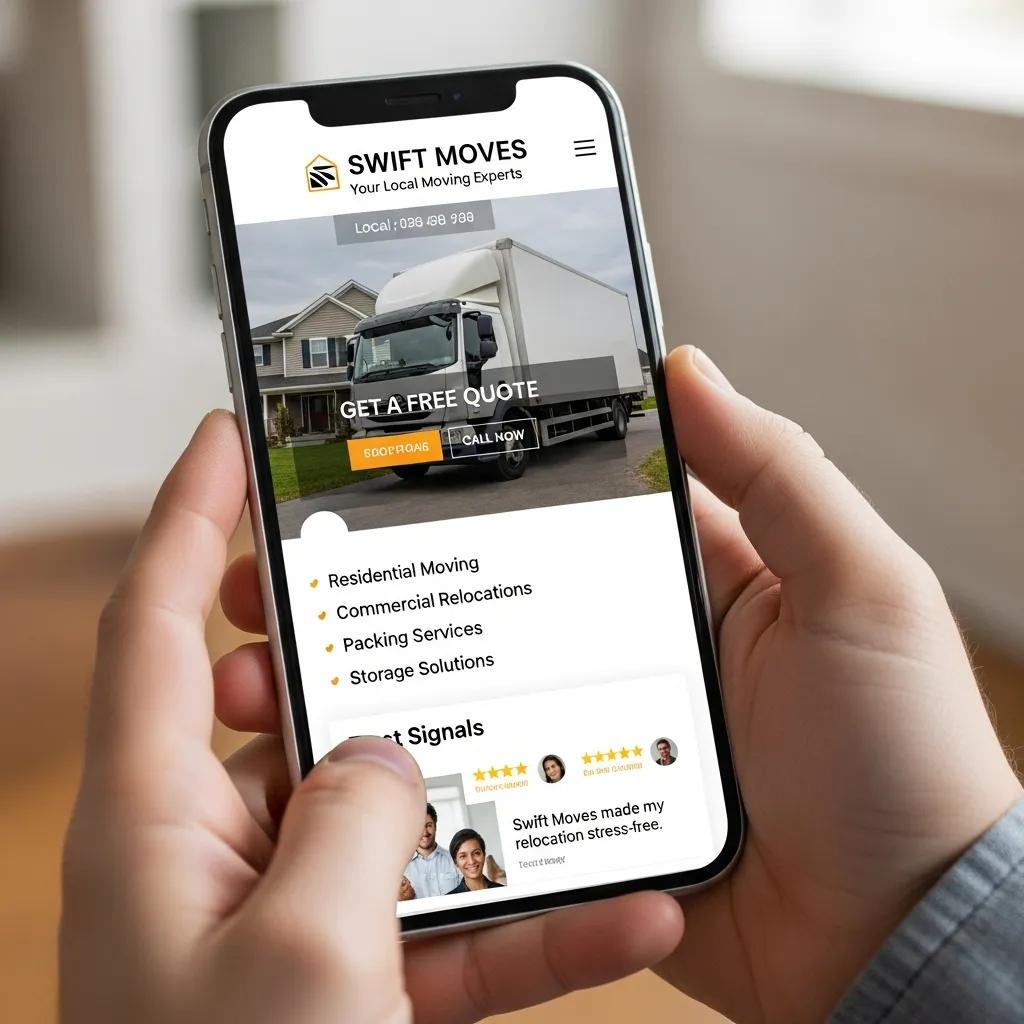
Local landing pages convert by answering the exact question a searcher has in the moment—service scope, pricing signals, service area, and an immediate CTA—so they reduce friction between discovery and booking. On mobile, the typical user needs fast load times, clear mobile CTAs (call, estimate form), and concise trust signals like reviews and badges; these elements boost both rankings and conversion rates. Design landing pages to include local signals (maps embed, neighborhood pages, testimonials with location mentions) and apply LocalBusiness schema for each service area. Focused landing pages plus mobile-first UX turn search visibility into booked moves, which is the ultimate KPI for moving companies.
Local landing pages should follow a simple template:
- Headline: Service + Location
- Brief value proposition and trust signals
- Service scope and pricing cues
- Clear CTA and estimate form
- Local testimonials and schema
These elements prepare the site to be recommended by AI-driven assistants and improve GBP synergy discussed next.
How Does AI Search Optimization Enhance Local SEO for Moving Companies?
AI Search Optimization (GEO) prepares your site and profiles to be discoverable by generative models and voice assistants that increasingly surface local recommendations without a traditional click. The mechanism is entity clarity: AI systems favor well-structured, authoritative entities that can be cited confidently in answers and local recommendations. For moving companies, entity-rich content—clear service definitions, consistent NAP, reviews, and structured data—makes it more likely a model will recommend your business for queries like “best movers near me” or “who offers same-day moves in [city].” This capability reduces dependency on traditional SERP clicks and can generate zero-click referrals and voice-driven leads.
Further academic research highlights how advanced AI models, like those based on ChatGPT, can be leveraged to optimize keyword strategies and significantly improve lead conversion rates.
ChatGPT for Lead Conversion & Keyword Optimization
In the vast domain of digital marketing, lead generation forms the foundation for business development. Business strategies depend on converting the leads into customers. It has become very crucial and challenging to choose an appropriate digital platform for marketing. The proposed method, called Stochastic Gradient ChatGPT-based Discretized Recurrent Deep Learning Classification (SG-CDRDLC), employs an efficient way for lead conversion based on influencing feature keywords. The DL classifier with two hidden layers allows companies to determine the popularity of the keywords in the first layer. The second layer measures the keyword density based on a variety of user queries to evaluate and enhance the conversion rate. The proposed model was trained and tested on three datasets and compared against existing methods using accuracy, precision, recall, and training time.
A Discretized Recurrent Deep Learning Classifier based on Stochastic Gradient ChatGPT to Improve Lead Conversion Rate, RM Ichangi, 2025
Below is a concise list of AI/GEO optimization tactics.
- Use FAQ and HowTo schema for short, answerable snippets.
- Structure pages with clear entity descriptors (what, where, how).
- Include authoritative citations and updated factual data for trust.
- Create concise, bulletized answers for immediate consumption by LLMs.
Structured content and schema help search engines and AIs attribute confidence to your business; next we’ll show how Stacked SEO’s AI/GEO capabilities illustrate this approach in practical terms.
After explaining AI benefits, it’s natural to mention practitioners that specialize in implementation. Stacked SEO focuses on industry-specific Local SEO and AI Search Optimization for moving companies, with offerings that optimize Google Maps and Local Pack presence, implement entity-rich schema, and align site structures with generative search signals. Their approach emphasizes transparency in tracking keywords, leads, and booked jobs and aims to accelerate noticeable ranking and qualified lead activity within 30–60 days. This example illustrates how AI/GEO work converts strategy into measurable outcomes for moving businesses.
What Are the Best Practices for Optimizing Moving Companies for ChatGPT and Google AI Mode?
To be surfaced by ChatGPT-like systems, provide concise Q&A blocks, structured facts, and HowTo steps that answer common moving questions directly and with citations where possible. Implement FAQ and HowTo schema so models can extract authoritative answers, and maintain a consistent, entity-rich site architecture that ties GBP data to landing pages. Use short, highlighted answer boxes near top of pages for common queries like pricing, availability, and insured services to increase likelihood of being quoted by generative answers. These practices make it easy for AI systems to reference your entity and send customers directly to your contact methods.
How Can Voice Search Strategies Increase Leads for Moving Businesses?
Voice search optimization focuses on conversational phrases and immediate actions like “call” or “get a quote,” so content should include natural-language question-and-answer blocks and short, directive CTAs. Target long-tail, local conversational queries (e.g., “who are movers open now near [neighborhood]”) and ensure GBP has up-to-date hours and real-time availability indicators. Provide succinct answers on landing pages and use structured data to increase the chance a voice assistant will read your response aloud and offer a call button. Optimizing for voice converts search intent into immediate phone calls and direction requests, which are high-value leads for movers.
What Off-Page SEO Techniques Build Authority and Generate Leads for Moving Companies?
Off-page SEO for movers builds domain authority and local relevance through targeted backlinks, consistent citations, partnerships, reviews, and content amplification that earn referral traffic. High-value links come from local business associations, real estate partner sites, storage providers, and neighborhood blogs; these links convey locality and trust to search engines. Citation consistency across directories ensures NAP reliability for entity recognition, while content-driven outreach—local moving guides, neighborhood pages, and case studies—creates shareable assets that attract links. Coordinating link outreach with a content calendar and local partnerships compounds authority over time and supports higher Local Pack prominence.
Introductory list: Prioritized backlink sources for movers.
- Local chambers of commerce and city business directories.
- Real estate agents and property management partners.
- Local news outlets and neighborhood blogs.
- Industry-specific directories and trade associations.
- Moving and storage service partners.
After implementing outreach, follow the citation audit process described next to maintain consistency.
How to Build Local Backlinks and Citations Effectively for Movers?
Begin with a citation audit: list existing directory entries, identify inconsistencies, and correct NAP across major directories and niche moving industry listings. Run prioritized outreach to partners with a short, personalized email template that explains mutual benefit (referral linking, co-branded content, or service pages). Create localized content assets—neighborhood moving guides, relocation checklists, case studies—that partners want to share or link to. Monitor backlinks and citations regularly to detect and fix discrepancies, since maintained consistency sustains entity signals and reduces ranking volatility.
Sample outreach template (concise):
- Introduce your company and mutual audience.
- Propose a content collaboration or referral arrangement.
- Offer a specific asset or page to link to and a clear next step.
This outreach cadence builds local authority and feeds the content ideas described next.
What Content Marketing Ideas Drive Engagement and Conversions in the Moving Industry?
Content that converts for movers addresses immediate logistical needs, reduces friction in the buying process, and demonstrates competence through evidence. High-performing formats include moving checklists, neighborhood guides, packing how-to videos, cost calculators, and localized case studies that show before-and-after results. Map content to the funnel: awareness (blog posts, neighborhood guides), consideration (cost calculators, packing tips), and decision (detailed service pages and testimonials). Repurpose long-form guides into short social clips and FAQ snippets to feed GBP posts and AI answer boxes, amplifying reach across channels.
Sample content calendar ideas (monthly rotation):
- Week 1: Neighborhood moving guide
- Week 2: Packing tips video + checklist
- Week 3: Case study with photos and reviews
- Week 4: Pricing explainer and CTA to request an estimate
These content formats support outreach and on-site conversion while generating assets linkable by partners.
How Can Moving Companies Measure SEO Success and Stay Ahead in Local Search Rankings?
Measuring local SEO success requires tracking GBP metrics, keyword rankings, organic traffic, leads, and conversion outcomes to connect SEO activities to booked jobs and revenue. Core KPIs include GBP views, search vs. discovery impressions, direction requests, phone calls, website form submits, local keyword rankings, and organic landing-page performance. Centralize reporting using a combination of Google Search Console, GA4, GBP Insights, and a rank tracker to monitor shifts and prioritize tests. A scheduled audit cadence—monthly for GBP and rankings, quarterly for technical and content audits—keeps the strategy iterative and responsive to market changes.
Introductory KPI list with suggested benchmarks.
- GBP views and discovery impressions: increasing month-over-month
- Calls and direction requests: track conversions per impression
- Local keyword rankings: prioritize top-20 local phrases
- Organic landing page conversions: monitor form-submission rates
The next table maps KPIs to tools and suggested benchmark ranges for moving companies.
This EAV-style mapping provides a clear monitoring framework and supports the experiment workflow below.
Which KPIs and Tools Are Essential for Tracking Local SEO Performance?
Essential KPIs include GBP impressions, clicks, calls, direction requests, organic sessions to landing pages, keyword rank for service-area phrases, and lead-to-booking conversion rates. Use GBP Insights for profile performance, GA4 for website behavior and conversions, GSC for query insights, and a rank tracker to measure local phrase movement. Establish dashboards that combine these sources to show the funnel from impression to booked move and set reporting cadences—weekly for GBP and urgent changes, monthly for rankings and conversions, and quarterly for full audits. These tools create the visibility needed to test optimizations and prove ROI.
How to Use Data to Continuously Improve Moving Company SEO Strategies?
Run iterative experiments using a hypothesis-driven workflow: define the hypothesis (e.g., faster landing page increases form submits), implement a controlled change (CTA placement or speed optimization), measure impact against KPIs, and iterate based on results. Use A/B tests for CTAs, track attribution for phone calls and form submits, and update underperforming pages with refreshed content or schema adjustments. Attribute booked jobs to SEO by tagging leads and recording source in your CRM; this connects organic visibility to revenue and helps prioritize future investments. Continuous measurement and testing create compound growth in visibility and booked moves.
Final monitoring table: KPI → Tool → Action.
This table ties measurement to action so teams can iterate quickly and preserve momentum.
For moving companies seeking hands-on execution, Stacked SEO specializes in industry-specific Local SEO and AI Search Optimization for movers. Their framework focuses on Google Maps and Local Pack positioning, entity-rich content, schema implementation, and transparent tracking of keywords, leads, and booked jobs with the goal of delivering measurable ranking jumps and qualified lead activity within 30–60 days. Engaging an expert partner can accelerate implementation of the processes described in this guide while maintaining auditability and measurable outcomes.
The final step is operationalizing audits, tests, and reporting on a consistent cadence so improvements compound and local dominance becomes sustainable through recurring optimization cycles.