

How to Dominate Google Maps Rankings for Moving Companies
Many moving companies struggle to appear in Google Maps and the Local Pack despite delivering excellent service, losing high-intent leads to better-ranked competitors. This guide breaks down the exact mechanisms behind Google Maps ranking — the Google Business Profile (GBP), on-site signals, citations and reviews (prominence), and modern AI/LLM visibility tactics — and shows how each element creates measurable lead growth for movers. You will learn which ranking factors matter most for service-area moving businesses, step-by-step GBP optimization, authority-building strategies (reviews, citations, local links), website upgrades that support local search, and practical AI workflows that speed results. The article maps directly to operational tasks you can implement or outsource, explains KPI measurement, and highlights managed options for teams that prefer expert support. Throughout, keywords like map ranking secrets, Google Business Profile optimization movers, and AI tools for local SEO movers are integrated to help you apply these tactics and dominate local map results.
What Are the Core Google Maps Ranking Factors for Moving Companies?
Google Maps ranking largely rests on three interconnected signals: relevance (how well your listing matches a search), proximity (how near you are to the searcher or targeted city), and prominence (how well-known and trusted your business is online). These factors work together: relevance determines match, proximity sets baseline visibility for service-area queries, and prominence tilts results through reviews, citations, and local authority. Moving companies must treat the triad as a system because improving one signal often amplifies the others — for example, richer GBP content (relevance) encourages more clicks and calls that increase prominence.
- Relevance: Accurate categories, services, and keyword-aligned descriptions help Google map intent to your listing.
- Proximity: Proper service-area settings and geo-grid strategies influence which local queries you can win.
- Prominence: Reviews, citations, local backlinks, and consistent NAP drive sustained Local Pack presence.
Improving these three areas requires coordinated GBP edits, reputation systems, and website support; the next sections show concrete actions for each component and how they interlock to improve rankings.
How Do Relevance, Proximity, and Prominence Impact Moving Company Rankings?
Relevance means Google understands your moving services and matches them to user queries; choose precise GBP categories, list specific services, and mirror high-value search phrases on your service pages to signal topical fit.
Proximity affects which searches show your listing first — for local jobs, being closer matters most, but for long-distance or statewide moves you can use multi-city content and service-area optimization to expand reach.
Prominence is built over time via review volume/velocity, local citations, and backlinks; these trust signals influence both map rank and the likelihood of Google showing your business in competitive queries.
Actionable steps movers can take include auditing GBP categories for exact matches, mapping service-area coverage across pages, and running a focused review-generation campaign to increase review velocity. Addressing duplicates and citation inconsistencies also improves prominence and reduces ranking volatility.
Improving relevance and prominence often increases click-through and calls, which signals to Google that your listing satisfies user intent and should appear higher.
Why Are Reviews and Citations Critical for Google Local Pack Success?
Reviews and citations form the backbone of prominence: they provide social proof, keyword-rich user content, and structured mentions that search engines use to validate business legitimacy. Review volume and velocity matter more than one-off high ratings — a steady stream of recent, detailed reviews demonstrates active service and increases trust.
Citations — directory listings that include your business name, address model for service area businesses, and service descriptions — reinforce NAP consistency and help Google corroborate your operating area and services.
A mini-checklist for reviews and citations:
- Request reviews at job completion via SMS, email, or in-person prompts to capture high-intent feedback.
- Audit top directories and industry lists for duplicates, inconsistent names, or incorrect service-area settings.
- Monitor review sentiment and respond promptly to build engagement and encourage further reviews.
Combining a continuous review funnel with structured citation cleanup reduces ranking dips and builds cumulative prominence that sustains Local Pack placement over time.
How to Optimize Your Google Business Profile for Movers
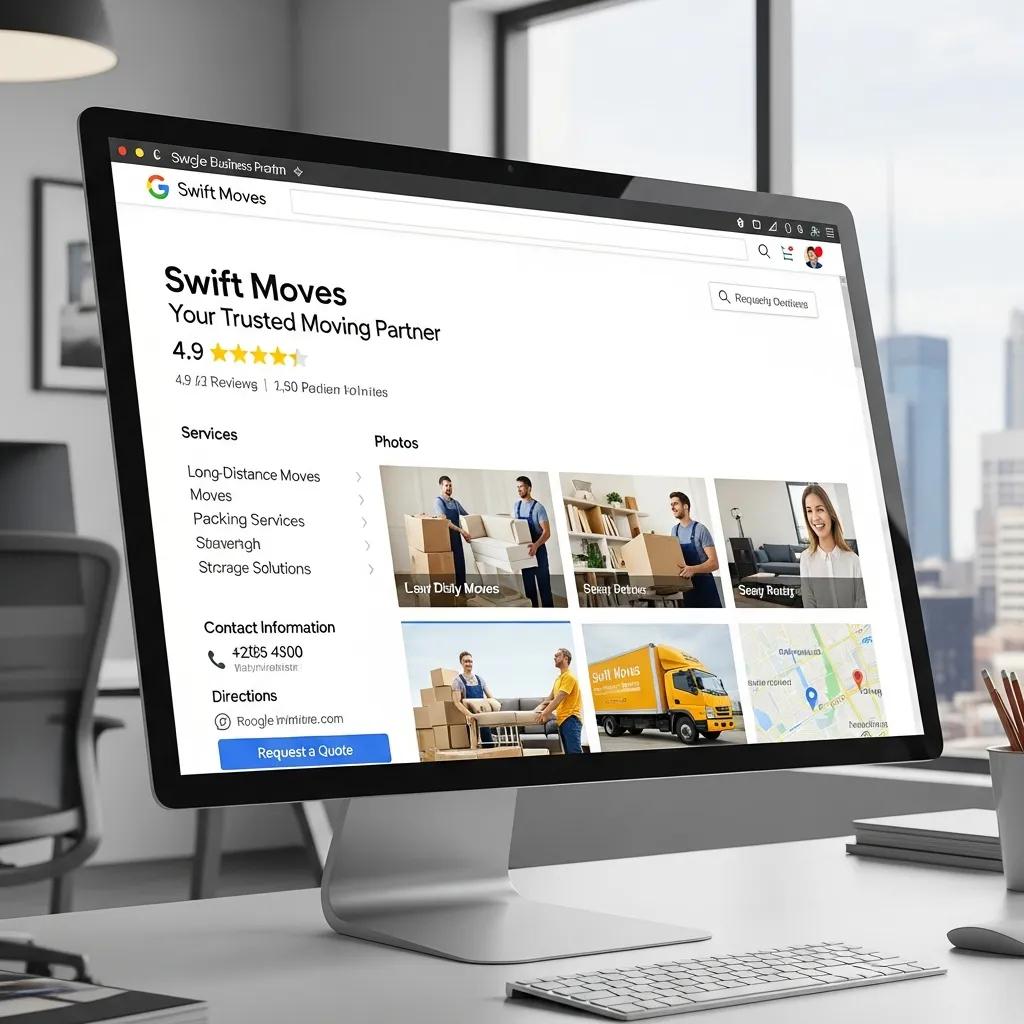
Optimizing your Google Business Profile starts with claiming and verifying the profile, completing every field with service-focused language, and configuring service-area options to match operational coverage. GBP optimization improves relevance and click-through rates because the profile presents your services, offerings, and proof points directly in map results. A well-structured GBP also feeds LLM and AI systems that extract business facts for AI Overviews, which boosts visibility across modern search surfaces.
Follow these step-by-step actions to capture quick wins:
- Claim and verify the GBP and confirm there are no duplicates that dilute signals.
- Populate primary and secondary categories, add all service descriptors, and craft a concise service-focused business description.
- Configure service area carefully, upload quality photos, publish regular GBP posts, and maintain an active Q&A and review response routine.
These steps prepare your GBP for advanced tactics like geo-grid testing and heatmap tracking that refine where you show up on maps. For teams that prefer a managed approach, Stacked SEO offers GBP optimization and ongoing GBP management as part of an All-In-One Growth Engine that centralizes GBP posts, Q&A, and reputation workflows without fragmenting tasks across multiple vendors.
Intro to the GBP fields table: The following table maps core GBP fields to recommended values for moving companies so owners can quickly audit and apply precise settings.
This EAV mapping helps movers avoid common misconfigurations and ensures GBP content aligns with how users search for moving services. Next we’ll cover claiming and verification specifics to prevent common profile issues.
What Are the Essential Steps to Claim and Verify Your Moving Company’s GBP?
Claiming and verifying a GBP starts with locating any existing profiles and choosing the correct verification path for service-area businesses; postcards are common, but phone or email verifications are sometimes available and faster. Avoid creating duplicates during the claim process by checking major directories and internal CRM lists first; duplicates can split reviews and weaken prominence.
If verification fails, document the error message, correct inconsistencies in official business identifiers, and request re-verification through Google’s support channels.
Practical troubleshooting tips include preparing proof of service area operations (insurance documents or licensure if needed), ensuring your display name matches business records, and establishing an audit cadence to re-check GBP settings quarterly. Regular audits reduce the chance of reintroduced duplicates and keep your profile optimized for relevance and trust.
These verification and audit steps create a stable foundation for scaling review generation and citation work that follows.
How to Complete Business Information and Service Area Optimization for Movers?
Completing profile information requires exact category selection, a curated list of services, and thoughtful service-area configuration that reflects operational reality without gaming proximity.
For local residential moves, use city-based service-area listings and tailored location pages; for long-distance moves, create content hubs targeting corridors and origin/destination pairs.
Visual assets and periodic posts should highlight service types and seasonal offers to drive engagement in GBP insights.
Geo-grid strategies help you test coverage: map out targeted zip codes or neighborhoods and measure impressions/clicks per cell to refine where you should invest in citations or local ads.
Image frequency recommendations include weekly photo updates for high-traffic profiles and monthly posts for consistent activity.
Completing these fields and optimizing service-area settings increases relevance and prepares listings to capture proximity-driven queries, which we’ll leverage further when building prominence and measuring outcomes.
What Strategies Build Authority and Prominence for Moving Companies on Google Maps?

Authority for movers is earned through systematic review generation, citation consistency, local link acquisition, and content partnerships that create trusted local signals. These strategies amplify prominence by increasing the quantity and quality of signals that Google uses to evaluate trustworthiness. A layered approach — immediate review funnels, mid-term citation campaigns, and long-term local PR/link efforts — produces the sustained prominence needed to dominate the Local Pack.
Key tactics to operationalize authority building:
- Establish a review funnel that requests feedback at optimal post-job moments.
- Implement a citation cleanup and structured submission plan across high-priority directories.
- Pursue local partnerships, sponsorships, and editorial content to earn contextual backlinks.
Below is a table that compares reputation and citation tactics by priority and recommended action to help teams allocate effort and budget effectively.
This EAV-style comparison helps prioritize actions that deliver the fastest prominence gains and supports a roadmap for sustained link and citation growth. With reputation systems in place, the next subsections detail review generation and advanced citation/link techniques.
How to Generate and Manage Google Reviews Effectively for Movers?
Generating reviews effectively hinges on asking at the right time, simplifying the process, and following a management cadence that maximizes conversion from satisfied customers. The ideal moment to request a review is immediately after job completion when satisfaction is highest; use SMS for immediacy and email for longer-form instructions. Provide a simple one-click pathway to leave feedback and use short, compliant templates that encourage descriptive reviews without offering incentives.
Sample implementation steps include creating an automated post-job message sequence, training crews on soft prompts to ask for reviews, and instituting a daily or weekly review-monitoring routine to respond.
Responding promptly to positive and negative feedback increases reviewer trust and demonstrates responsiveness to Google and users.
Effective review systems raise velocity and volume, which directly strengthens prominence in map rankings.
What Are Advanced Citation Building and Local Link Building Techniques?
Advanced citation and link-building focuses on high-impact directories, local sponsorships, and editorial opportunities that provide contextual relevance and referral traffic.
Prioritize industry-specific directories and local chamber listings first, then expand to niche community resources and regional guides that cover moving logistics or neighborhood relocation tips.
For backlinks, create neighborhood moving guides, data-driven local studies, or interactive tools that community sites want to reference.
Outreach templates should emphasize mutual value — for example, offering a neighborhood moving checklist in exchange for placement on a community portal.
Monitor citation health with periodic audits and address harmful duplicates or outdated listings promptly.
These advanced tactics generate local authority signals that reinforce GBP prominence and improve long-term map ranking stability.
How to Optimize Your Moving Company Website for Local Search Visibility
Your website must support GBP with location-specific content, fast mobile performance, and structured data that communicates services to search engines. On-site signals like schema markup, locally focused landing pages, and mobile-first design enhance relevance and provide conversion pathways when prospects click through from the Local Pack. Technical optimizations also improve user experience — a primary ranking trigger for local organic search.
A concise website optimization checklist:
- Implement LocalBusiness, Service, and Review schema on service and location pages.
- Create city or neighborhood landing pages with unique content and local keywords.
- Improve Core Web Vitals—optimize images, leverage caching, and minimize third-party scripts.
These measures connect GBP engagement (clicks and directions) to your website experience, increasing conversion rates and providing behavioral signals that support visibility. The next subsections unpack mobile performance and on-page SEO templates for location pages.
Why Is Mobile-Friendly Design and Fast Loading Crucial for Local SEO?
Mobile-first behavior dominates local search because users often search on-the-go for immediate services; fast load times and touch-friendly layouts reduce bounce rates and increase conversions from map clicks.
Core Web Vitals — metrics for loading, interactivity, and visual stability — influence user satisfaction and can indirectly impact rankings by altering engagement signals.
Prioritize compressing images, enabling server-side caching, and using efficient hosting to reduce time-to-interactive.
Measure impact with PageSpeed Insights and Lighthouse audits, then prioritize fixes that show the largest wins: image optimization, removing render-blocking JavaScript, and caching policies.
Improving mobile performance increases the likelihood that visits from GBP lead to phone calls or booking forms, which in turn conveys higher quality and relevance to search engines.
After technical fixes, focus on on-page SEO and structured content to capture local intent.
How to Implement On-Page SEO and Location-Specific Content for Movers?
On-page SEO for movers means using title and heading templates that combine service and location, creating FAQ blocks that answer common moving questions, and applying LocalBusiness and Service schema to reinforce entity signals.
Build pages with titles like “City Name Movers — Local & Long-Distance Moving Services” and include structured FAQs to target voice and LLM queries.
Internal linking should funnel authority from broad service pages to specific neighborhood landing pages for geo-targeted ranking.
Content ideas include local moving checklists, neighborhood guides, packing tips, and transparent booking steps; these provide both relevance and opportunities for earned links.
Implement schema snippets for reviews and aggregate ratings to enhance SERP features.
Strong on-page work supports GBP relevance and prepares content to be referenced by AI/LLM systems that extract factual answers for users.
How Can AI and LLM Technologies Enhance Google Maps Rankings for Moving Companies?
AI and LLMs accelerate local SEO by automating repeatable tasks, generating structured content for LLM extraction, and improving lead qualification through voice automation. AI workflows can draft review responses, create FAQ-rich content optimized for entity extraction, and discover citation opportunities at scale. Leveraging LLM visibility tactics — structured answers, clear entity definitions, and schema markup — helps moving companies appear in AI Overviews and conversational search results that feed downstream click and call behavior.
Common AI-driven benefits include faster content production, more consistent citation audits, and higher review response throughput.
These outcomes shorten the time from optimization to measurable visibility gains when combined with human QA.
The next subsections explain specific automation workflows and practical LLM strategies movers can adopt.
In What Ways Does AI Automate and Accelerate Local SEO for Movers?
AI automates tasks such as creating GBP posts, drafting review request messages, scanning the web for missing or inconsistent citations, and generating initial drafts of location pages with embedded schema.
For example, a citation discovery workflow can scan target directories, flag discrepancies, and generate a prioritized action list that reduces manual audit time from days to hours.
AI also supports templated outreach for link-building and local PR.
Time-saving scenarios often translate into faster prominence gains because more tasks are completed consistently and at scale; however, human oversight remains necessary for quality control and compliance with platform policies.
Automation is best used to augment staff capacity and enable strategic focus on relationships and complex outreach that requires a human touch.
Stacked SEO applies AI-driven systems in managed programs, including an AI Voice Agent for call handling and lead qualification and LLM optimization capabilities that improve content extraction and visibility. These capabilities are presented as examples of how automation supports lead quality and faster ranking improvements without replacing essential human verification.
What Are Effective LLM Visibility Strategies Using ChatGPT, Gemini, and Grok?
To surface in LLM-driven answers and AI Overviews, structure content around clear entities and relationships, use schema to mark services and reviews, and craft FAQs with concise, direct answers that LLMs can extract.
Entity-rich headings, explicit service lists, and standardized phrasing improve the chance an LLM will cite your content as a primary source.
Monitor LLM visibility by tracking mentions in AI-focused tools and iterating prompts and structured content patterns.
Also, produce short, authoritative snippets (40–80 words) for common questions and place them in schema-backed FAQ blocks; these are highly extractable by LLMs.
Combine these tactics with structured data and consistent citations to strengthen your authoritative signal across both traditional search and AI-driven surfaces.
These strategies complement GBP work and web optimization to create a unified visibility approach.
How to Measure Success and Continuously Improve Your Google Maps Ranking
Measuring local performance requires tracking GBP impressions, clicks, calls, directions, review count and rating, and correlating these signals to lead volume and booked moves. Regular monitoring reveals whether changes in GBP content, review velocity, or link-building campaigns move the needle on real business outcomes. A disciplined measurement cadence — weekly for alerts, monthly for performance trends, and quarterly for strategy shifts — enables continuous improvement.
Below is an EAV-style KPI table that clarifies key metrics and how to measure them so moving companies can align SEO activity with booked-move outcomes.
Using these KPIs, map low-level signals to business outcomes — for example, convert calls into booked moves and calculate average move value to estimate ROI from local SEO efforts. This metric-driven loop informs which tactics to double down on and where to pivot.
Which KPIs Best Reflect Moving Company Performance in Google Local Pack?
Primary KPIs are GBP impressions, clicks, calls, directions, and review-related metrics; each reflects a different stage of the local funnel from discovery to intent to conversion. Secondary KPIs include organic position for service-area pages, referral traffic from local directories, and booked-move conversion rates from leads generated via GBP. Tie each KPI back to revenue by tracking phone calls and lead forms into your CRM and assigning average move value to estimate impact.
A simple ROI example: if a 20% lift in GBP calls leads to five additional booked moves per month at an average move value, you can calculate payback and adjust investment in review generation or citation campaigns accordingly. Tracking these KPIs regularly enables data-driven decisions and clearer justification for managed services when growth stalls.
What Tools and Processes Support Ongoing Monitoring and Optimization?
A compact tool stack should include a local rank tracker with geo-grid capability, GBP Insights, GA4 for site behavior, a reputation management system for reviews, and a citation monitoring tool for directory health.
Weekly alerts should flag sudden review drops or listing suspensions, while monthly reports track trends and attribution.
Establish a process with roles: a weekly operator to handle GBP posts and review responses, a monthly analyst to interpret KPIs, and a quarterly strategist to plan campaigns.
For teams that prefer outsourcing, a managed partner can centralize these tools and processes; Stacked SEO’s All-In-One Growth Engine integrates SEO, PPC, AI automation, GBP management, and reputation services to streamline monitoring and optimization across channels. For companies that keep work in-house, adopting the outlined toolset and cadence will create a reliable feedback loop to sustain and grow Local Pack dominance.
For a personalized roadmap or to discuss managed options like the All-In-One Growth Engine and AI Voice Agent, consider scheduling a discovery conversation with a specialist who can map these recommendations to your specific service areas and growth targets.