

Technical SEO for Movers: Speed, Mobile & Core Web Vitals
Technical SEO for movers focuses on the infrastructure, performance, and structured signals that make service pages and local listings rank and convert. Improving page speed, mobile experience, and Core Web Vitals reduces lost leads, increases click-to-call and booking completions, and directly impacts Local Pack visibility for moving companies. This article explains how speed metrics map to user behavior, what mobile-first indexing requires for movers, and which Core Web Vitals (LCP, INP, CLS) most often sabotage conversions on image- and form-heavy moving sites. You will get prioritized technical tactics, monitoring KPIs, schema strategies to surface in voice and AI responses, and practical implementation checklists tailored to the moving industry. Throughout, we reference tools and measurable outcomes while showing where focused agency support can accelerate results for moving businesses.
How Does Website Speed Impact Moving Company SEO and User Experience?
Faster websites reduce friction and increase conversions by lowering time-to-interaction and ensuring critical booking elements render quickly for prospective customers. For moving companies, delays in hero images, interactive quote forms, or map embeds increase bounce rates and reduce click-to-call and booking completions, so speed improvements translate directly into more booked moves. Search engines correlate faster load times with better UX signals, which can improve rankings for competitive local queries; this relationship is strongest where users expect instant local service answers. Monitoring TTFB, First Contentful Paint, and LCP gives a clear view of where seconds are lost and which technical fixes will recover calls and form submissions. Below are quick best-practice wins that often yield measurable conversion improvements within weeks.
Quick wins for moving websites:
- Optimize and serve hero and gallery images in modern formats and responsive sizes to cut payloads and improve LCP.
- Enable caching strategies and set cache-control headers for static assets so repeat visitors and map lookups load instantly.
- Use a CDN and minimize third-party scripts (tracking, chat widgets) to reduce TTFB and eliminate main-thread blocking.
These prioritized actions restore critical content and interaction speed, which in turn lowers abandonment and improves ranking signals that drive local visibility and leads.
EAV comparison of key speed factors for movers
This table helps prioritize remediation: server and media optimizations usually deliver the largest conversion gains first.
What Are Key Strategies for Moving Company Website Speed Optimization?
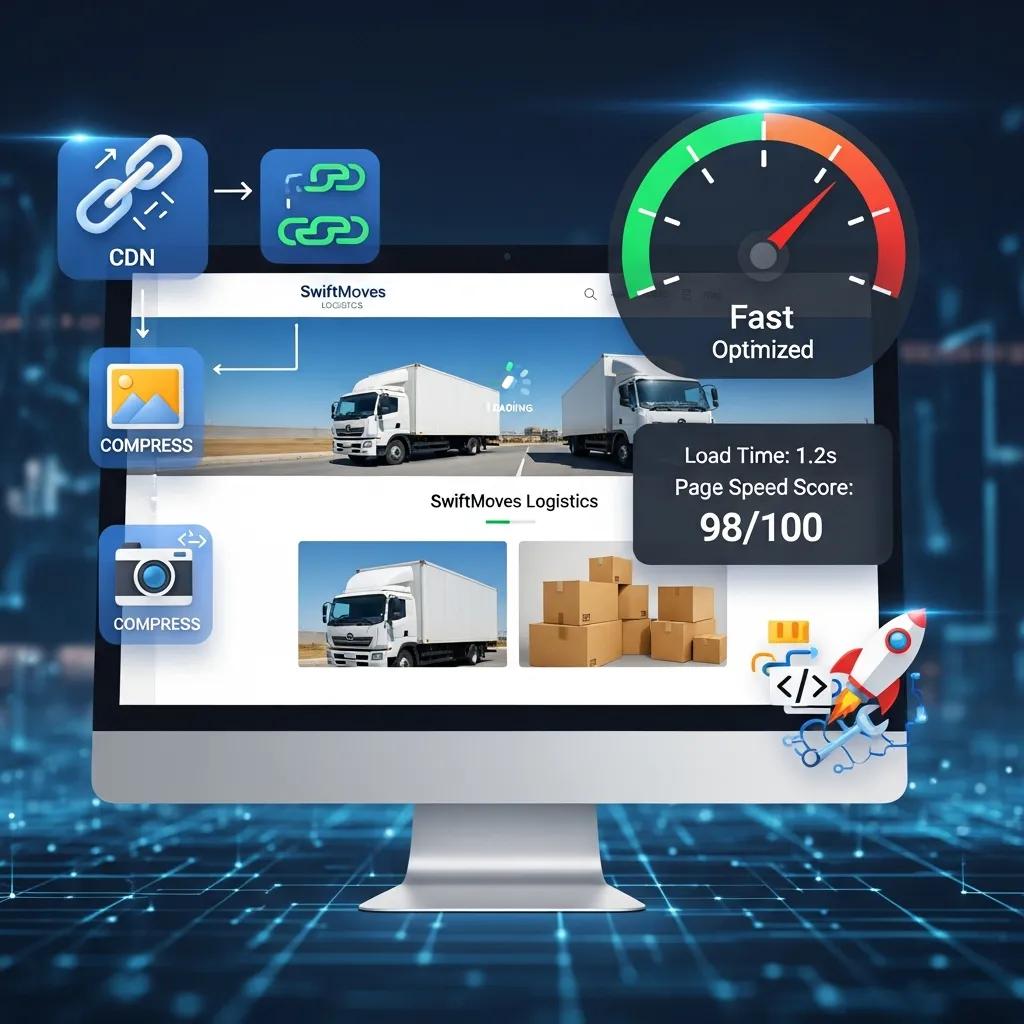
Key speed strategies target heavy visual assets and interactive booking flows typical for movers and prioritize fixes by impact and implementation cost. Start by auditing payloads to identify oversized hero images, unoptimized gallery photos, and video embeds which disproportionately inflate LCP. Next, focus on network-level improvements—enable HTTP/2 (or HTTP/3 where supported), configure CDN edge caching for assets and APIs, and set conservative cache lifetimes for static files while using cache-busting for deploys. Tactically, convert images to WebP/AVIF, implement responsive srcset patterns, lazy-load non-critical media, and inline critical CSS for above-the-fold content to remove render-blocking resources. Finally, reduce third-party script impact by deferring non-essential scripts and loading analytics via lightweight wrappers to preserve input responsiveness.
Checklist and expected impact mapping
This approach prioritizes high-ROI changes first, then iterates on remaining third-party and code-level optimizations to compound gains.
Why Is Mobile SEO Essential for Moving Businesses in a Mobile-First World?
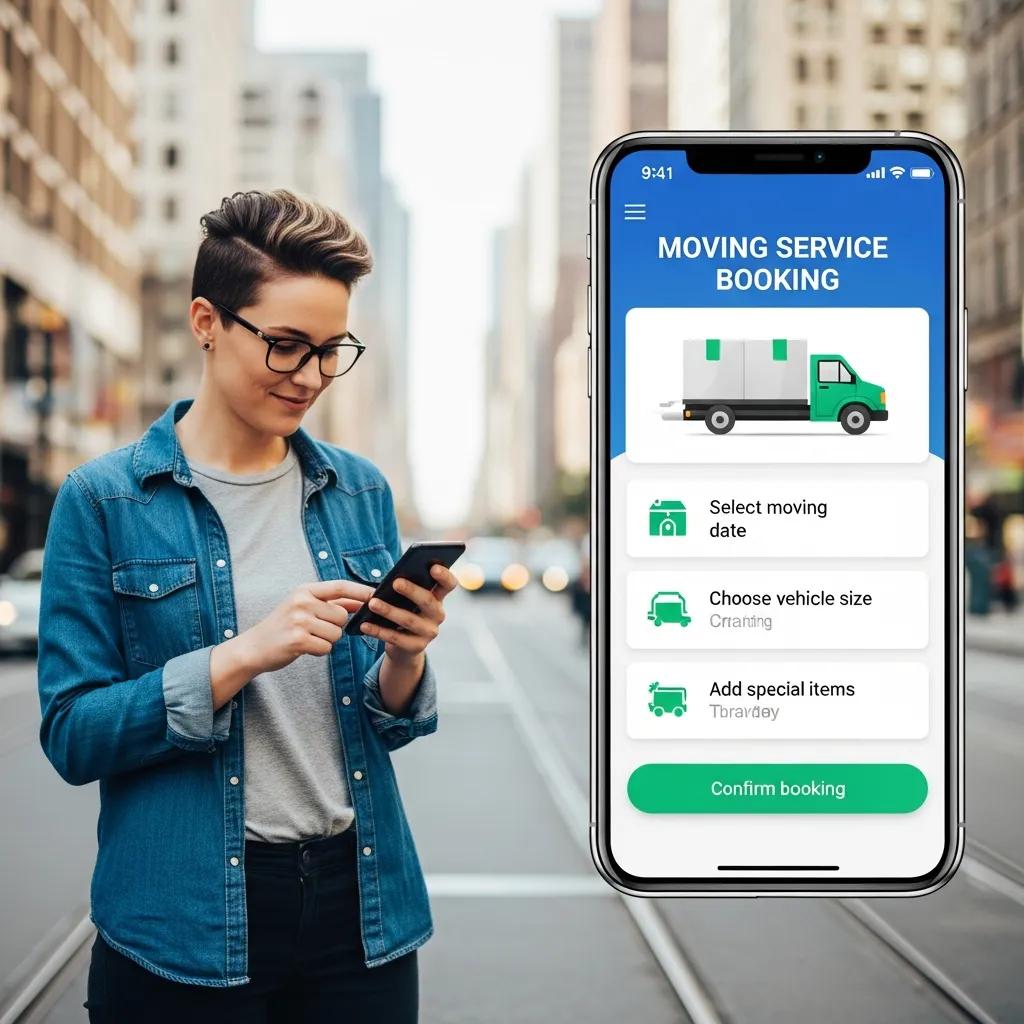
Mobile-first indexing means Google predominantly uses the mobile version of a site for ranking and understanding content, making a mobile-optimized experience essential for local moving queries. Prospective customers often search on-the-go with intent to call or request a quote, so mobile UX directly drives high-intent actions like tap-to-call and quick booking forms. Mobile SEO for movers therefore blends pure performance with UX — responsive layouts, optimized touch targets, and simplified mobile forms reduce friction and increase conversion rates for immediate service requests. Prioritizing mobile speed and usability also improves local pack signals and map interactions, which are core acquisition channels for moving companies.
Key mobile optimization steps for movers:
- Ensure responsive design and fast mobile rendering so key CTAs are visible on first paint.
- Optimize touch targets, minimize form fields, and enable click-to-call for instant lead capture.
- Prioritize mobile-specific performance: image compression, critical CSS, and service worker caching.
Adopting these mobile-first measures reduces friction for users who call or book immediately, improving both conversions and the mobile search signals that influence local rankings.
How to Implement Mobile-Friendly Design and Touch Optimization for Movers?
Implementing mobile-friendly design for moving sites starts with prioritizing the most conversion-critical elements above the fold: clear phone CTA, a concise quote form, and trust signals like reviews or service badges. Use recommended touch target sizes (at least 48×48 CSS pixels) and ensure spacing around CTAs to prevent mis-taps during quick interactions. Simplify mobile forms by reducing required fields, using input types that trigger relevant keyboards, and implementing inline validation to speed completion. Provide a sticky or persistent click-to-call CTA and consider progressive disclosure for service details to keep mobile pages lightweight while still informative. Run A/B tests on CTA prominence and form lengths to quantify the tradeoff between lead volume and lead quality.
Practical design rules and CSS guidance:
- Use large, high-contrast CTA buttons with accessible text to improve tap success.
- Implement inputmode and autocomplete attributes to reduce typing time.
- Use a single-column layout for mobile and reserve heavier gallery elements for secondary pages.
These implementation details lower input friction and improve mobile conversion rates for immediate lead generation.
What Are Effective Voice Search Optimization Techniques for Moving Services?
Voice search optimization for movers focuses on natural-language, concise answers to common conversational queries and strong local signals so assistants can confidently cite your business. Map common voice queries—like “movers near me,” “cost to move two-bedroom apartment,” or “same-day movers”—and craft short, authoritative answers in plain language that match spoken phrasing. Place those Q&A pairs prominently on service pages and hub pages, then mark them with FAQPage schema to improve the chance of being used by voice assistants. Strengthen local signals with clear areaServed descriptions and consistent NAP-like mentions (without inventing contact details) across content to help assistants resolve local intent. Finally, monitor assistive channels and long-tail conversational queries to expand the voice-optimized answer set.
Voice optimization tactics in short form:
- Use natural, direct answer sentences and include location context when applicable.
- Implement FAQ content with short answers and schema so assistants can extract facts.
- Monitor conversational queries and iterate answers to reflect user phrasing.
These tactics improve the likelihood that AI assistants will reference your site for transactional voice queries.
What Are Core Web Vitals and Why Do They Matter for Moving Company Websites?
Core Web Vitals are a set of field metrics—Largest Contentful Paint (LCP), Interaction to Next Paint (INP), and Cumulative Layout Shift (CLS)—that measure loading, interactivity, and visual stability; they matter for movers because booking flows and image assets are central to conversions. LCP measures the time until the largest visible element renders and influences first impressions on gallery and service pages. INP reflects input responsiveness and is crucial for quote forms and interactive price calculators used by moving customers. CLS measures unexpected visual shifts that can cause mis-taps on CTAs or form fields, directly reducing completed bookings. Improving these metrics reduces abandonment, raises conversion rates, and aligns site UX with ranking signals.
Core Web Vitals explained for movers
Understanding these metrics helps teams prioritize fixes that directly improve booking completion and local ranking signals for moving services.
Following a prioritized remediation roadmap that starts with LCP and INP typically yields the fastest business impact, because returning users and local searchers convert when essential content and interactions render predictably and quickly.
How to Improve Largest Contentful Paint for Moving Sites?
Improving LCP on moving websites targets the largest visible resource—often a hero image, promotional banner, or map embed—and the network/server path that delivers it. Begin by identifying the LCP element via field reports in PageSpeed Insights or Google Search Console and then ensure that element is prioritized: preload key hero images, serve them in WebP/AVIF with responsive srcset, and inline critical CSS for above-the-fold presentation. Reduce server response times by leveraging edge caching and a CDN, and move heavy tasks or fonts out of the critical rendering path by deferring or asynchronously loading non-essential assets. For map embeds, replace synchronous embeds with lightweight placeholders and load the full map only on interaction to preserve initial paint speed.
Tactical steps to reduce LCP:
- Preload the primary hero image and critical font used in the hero.
- Serve responsive images and use client hints where supported.
- Tune server caching and CDN rules to shorten TTFB for critical HTML.
These targeted changes lower the time users wait to see the page’s primary message, improving both perceived performance and conversion likelihood.
How to Enhance Interaction to Next Paint and Fix Cumulative Layout Shift Issues?
Improving INP and fixing CLS requires focusing on JavaScript execution and predictable layout behavior that directly affects form responsiveness and CTA stability for movers. Reduce long JavaScript tasks by breaking up heavy scripts, deferring non-critical JS, and optimizing event handlers to complete quickly so input events register without delay. For CLS, always specify width and height attributes for images and videos or use CSS aspect-ratio boxes to reserve space; reserve space for dynamic elements like banners, chat widgets, or injected third-party content to avoid sudden shifts. Test changes in both lab and field environments—Lighthouse for lab checks and Chrome UX Report or PageSpeed Insights for field metrics—to verify improvements in real-user conditions.
INP and CLS checklist for moving sites:
- Audit long tasks and split or lazy-load expensive scripts to improve responsiveness.
- Add explicit dimensions or aspect-ratio CSS to all media and third-party placeholders.
- Use font-display strategies to avoid layout reflows caused by late-loading web fonts.
These practices ensure forms and CTAs remain immediately usable and visually stable, reducing accidental clicks and increasing successful contact or booking actions.
How Can Schema Markup and Structured Data Boost Technical SEO for Moving Companies?
Schema markup gives search engines machine-readable context about business type, services offered, geographic coverage, and common customer questions, which increases the likelihood of rich snippets, PAA features, and better AI/assistant answers. For moving companies, LocalBusiness or MovingCompany schema communicates service area and contact points, Service schema clarifies the types of moves offered, and FAQPage schema provides concise Q&A pairs that feed featured snippets and voice assistants. Proper JSON-LD implementations tuned for moving-specific properties help search engines and AI models attribute ownership of authoritative answers, which supports both organic click-through rates and assistant-driven referrals. Below are implementation templates and practical tips for testing and validation.
Schema types, key properties, and example use-cases
Implementing these schema types improves the chance of rich results and more accurate AI sourcing for transactional queries.
What Are Best Practices for Implementing LocalBusiness and Service Schema for Movers?
Implement LocalBusiness and Service schema using JSON-LD placed in the page head or just before the closing body tag, ensuring properties accurately reflect service areas and offerings without duplicating structured content across many pages. Include areaServed with explicit service regions (e.g., city or county names), serviceType for distinct offerings (residential move, commercial move, storage), and contactPoint entries when you can supply validated contact methods—avoid inventing details not present on the site. Validate markup with Rich Results and structured data testing tools, monitor Search Console for errors, and keep schemas synchronized with visible page content to prevent mismatch issues that can inhibit rich result eligibility.
Implementation best practices checklist:
- Keep JSON-LD authoritative and consistent with on-page content to avoid mismatch errors.
- Use specific serviceType values and areaServed to improve local relevance.
- Validate and monitor structured data regularly to catch errors caused by CMS updates.
Following these practices ensures schema helps search engines and AI assistants correctly attribute services and increases the chance of enhanced SERP features.
How Does FAQPage Schema Improve Search Visibility for Moving Company Websites?
FAQPage schema converts concise, authoritative Q&A content into machine-readable snippets that frequently trigger People Also Ask boxes, featured snippets, and answers in voice assistants; for movers, this means direct answers to pricing, availability, and service policies can be surfaced without additional clicks. Craft FAQs that mirror real conversational queries—short question phrasing and direct one- or two-sentence answers—then implement them on relevant service or hub pages. Use schema only for factual Q&A that reflects the page’s actual content and avoid including promotional or speculative answers. Monitor impressions and clicks from Search Console to measure rich result impact and iterate on questions that get traction with users and AI assistants.
FAQ implementation tips:
- Select high-intent, conversational questions that match voice and snippet patterns.
- Keep answers concise and authoritative to maximize extraction probability by AI.
- Place FAQs near service descriptions so schema matches visible content.
Well-structured FAQ content both improves immediate user understanding and feeds AI-driven discovery channels.
How Is AI Search Optimization Shaping the Future of Technical SEO for Moving Companies?
AI search optimization (GEO — Generative Engine Optimization) changes how answers are sourced and surfaced: language models and assistant layers increasingly favor concise, authoritative, structured content and explicit citation signals. For moving companies, this means that well-structured service descriptions, validated schema, and high-quality FAQ answers increase the chance that AI assistants will cite a business for transactional queries. GEO also values authoritative signals and topical depth; therefore, a clear content architecture that connects service pages, local coverage, and review or case-study evidence helps models attribute trust. Monitoring AI referral channels and optimizing for short, machine-friendly answers is now a complementary channel to traditional organic ranking.
Tactical GEO recommendations for movers:
- Provide short, factual answer snippets for common queries and mark them with FAQPage schema.
- Maintain authoritative service descriptions and local context so AI can resolve intent accurately.
- Use structured data and consistent semantic markup to help LLMs attribute content to your site.
These steps help ensure moving companies remain discoverable as AI assistants become a primary discovery layer for local service queries.
What Is Generative Engine Optimization and Its Role in Moving Company SEO?
Generative Engine Optimization (GEO) prepares content and structured signals so generative AI systems can reliably source and summarize a business’s offerings for users. GEO involves concise answer snippets, strong schema signals, and content authority that ties local context to services offered. For movers, GEO means optimizing service pages and FAQs so that assistants can answer pricing ranges, availability, and service areas with confidence, which in turn can drive higher-quality referrals and calls. Prioritize content that directly answers transactional queries and ensure structured data reflects the same facts on-page; these signals increase the likelihood of being cited by AI.
Core GEO components to prioritize:
- Concise, citation-ready answers to transactional queries.
- JSON-LD schemas that expose service and local scope.
- High-quality, authoritative content that demonstrates topical depth.
Implementing GEO helps moving businesses capture AI-driven demand and turn it into measurable calls and bookings.
How to Optimize Moving Websites for AI Assistants Like ChatGPT and Google AI Mode?
Optimizing for AI assistants requires crafting short, authoritative answer snippets and ensuring structured data and content provenance are clear so models can attribute and surface your content. Create a prioritized set of Q&A pairs that answer the most common transactional queries in direct language and include them with FAQPage schema on service or hub pages. Use structured Service and LocalBusiness schema to provide machine-readable signals about service area and offerings, and publish consistent, verifiable facts on pages that can serve as citations. Monitor AI-channel engagement and iterate on phrasing and schema as assistant behavior evolves, ensuring your site remains a high-quality source for generative answers.
Practical checklist to optimize for AI assistants:
- Author short (one- to two-sentence) answers to common transactional queries and mark them with FAQ schema.
- Ensure structured data (Service, LocalBusiness) matches visible content for trustworthy AI sourcing.
- Track AI referrals and refine phrasing and markup to improve citation likelihood.
These tactics make moving websites more likely to be selected as sources by AI assistants, driving discoverability and high-intent traffic.
Stacked SEO is a digital marketing agency built on data, AI, and creativity, with a mission to drive measurable growth, more leads, and lasting visibility for brands. The service pages indicate a specialized focus on the moving industry. Primary services aligning with this topic: “SEO for Movers” (including technical optimization, Google Maps and Local Pack domination) and “GEO for Movers” (AI/LLM search future-proofing). UVPs noted in the SERP report include industry-specific expertise, a data/AI/creativity-driven approach, focus on high-intent conversions like phone calls and bookings, rapid ranking and lead improvements in approximately 30-60 days, and transparent reporting on keywords, leads, and booked moves.
– If you want a technical audit or consult, consider requesting a focused evaluation of Core Web Vitals and mobile performance from a specialized provider that understands moving-industry conversion patterns.
– For teams prioritizing AI visibility, include GEO-oriented content and FAQ schema as part of a broader technical road map.
– For immediate impact, prioritize LCP and INP fixes along with mobile CTA optimization to recover lost conversions quickly.
These targeted interventions combine technical remediation with content and schema signals to drive measurable lead growth for moving companies.