

Advanced Semantic SEO: A Practical Playbook for Moving Companies
Search engines and AI agents no longer rely on keyword matching alone — they read pages as networks of entities, attributes, and intent. This guide shows moving companies how to shape those signals so you attract more qualified visibility and higher‑quality leads. You’ll get a clear definition of semantic SEO, step‑by‑step instructions for using structured data and schema to mark up moving services, and a practical approach to building topic clusters and knowledge‑graph signals that strengthen both local and national queries. Many movers still focus only on keywords — which underdelivers for AI‑first search formats. Here we cover the essential schema types, where to place JSON‑LD, how to link entities internally, and tactics for AI search optimization so you can close that gap. Examples and EAV-style tables appear throughout to make implementation straightforward — start with our semantic SEO checklist for movers at SEO for Movers.
Semantic SEO for Movers: Boosting Search Engine Understanding
Semantic SEO arranges content and metadata so search engines and language models see clear entities, their attributes, and how they relate to one another. By structuring pages around explicit nodes — for example MovingCompany, Service, AreaServed, and Review — you make it easier for search systems to match pages to user intent and to surface rich formats. For moving businesses this delivers concrete benefits: eligibility for rich snippets, stronger local knowledge signals, and better placement in AI answers — all of which can drive more qualified leads. Below we show how entities and topic clusters form the backbone of topical authority for the moving niche and offer a cluster map you can use to organize service pages and content hubs.
How Do Entities and Topic Clusters Build Topical Authority for Movers?
Entities and topic clusters are complementary. A hub page defines the primary entity (for example, Long Distance Moving) while linked cluster pages cover related subtopics — residential moving schema, commercial moving schema, packing services schema — demonstrating comprehensive expertise. A long‑distance cluster usually includes a central guide plus pages for quotes, insurance, packing, interstate rules, and logistics; semantic anchor text on internal links makes relationships explicit. Search systems infer authority when related attributes are covered and when schema and internal links reference consistent entity identifiers, increasing your chances of appearing in knowledge panels and answer boxes. This structure also improves AI embeddings by creating clear, connected contexts that LLMs map to stable entity vectors and use to generate concise answers.
Academic work supports the idea that measuring relationships between topical categories and authoritativeness is essential for accurate information retrieval and ranking.
Topic Models & Authority Ranking for Knowledge Categories
The expert‑finding problem focuses on identifying people with specialized knowledge across particular domains and ranking their authority. This research develops scalable topic models to measure relevance between categories using both content and interaction signals, and it proposes a topical link‑analysis method that ranks authority by considering information within the target category and related categories.
How Does Structured Data Improve Visibility for Moving Companies?

Structured data tells search engines exactly which entities appear on a page and which attributes belong to them, improving indexing accuracy and enabling eligibility for rich results, knowledge panels, and other SERP features. For movers, implementing LocalBusiness and Service schema with accurate properties — name, serviceType, areaServed, priceRange, aggregateRating — produces stronger entity signals that search engines and AI assistants can use to surface concise, trustworthy answers. Correct JSON‑LD placement, validated markup, and consistent citations improve click‑through rates from rich features and make it easier for AI systems to cite your information. The table below compares essential schema types and their primary properties; the following section gives actionable JSON‑LD implementation and validation steps so your markup is discovered and indexed reliably.
Common schema types and the benefits they provide for moving services:
Which Schema Markups Matter Most for Moving Services?
The core schema types to implement are LocalBusiness (or a moving subtype), Service, Review, and FAQPage — they map directly to how people search for movers. LocalBusiness links brand and location signals to your services; Service clarifies specific offerings like packing or long‑distance moves; Review exposes aggregateRating to influence CTR; and FAQPage lets you capture common hiring questions. Include supporting properties — geoCoordinates, priceRange, serviceOutput, aggregateRating — so search systems can quantify your offerings. When combined properly, these schemas make entity recognition explicit, improving local SEO and feeding AI answer mechanisms that depend on well‑structured facts.
How to Implement JSON‑LD Effectively on Moving Websites
Add JSON‑LD markup as a single script block per entity in the head or body, and make sure canonical values in the markup match visible page content to avoid mismatches. Start with a LocalBusiness or Organization block referencing the site’s official name and service types, add Service blocks for each offering, and attach Review and FAQPage blocks where relevant. Use standardized place names for areaServed to help entity linking. Validate markup with schema testing tools, fix warnings or missing recommended properties, and resolve any differences between visible text and JSON‑LD. Place structured data close to the content it describes and use consistent entity labels across pages so internal links and schema together form coherent graphs for search engines to ingest.
Stacked SEO is a marketing agency focused exclusively on the moving industry. Our core offerings include the All‑in‑One Growth Engine (SEO, PPC, AI voice agents, automation), SEO for Movers, and AI Search Optimization for Movers. Our competitive advantages shown in SERP research: industry specialization, AI and LLM readiness, transparent, measurable results (including a Profit or Free Guarantee™), and an integrated approach that combines SEO, PPC, voice agents, content strategy, and conversion tracking.
What Is Knowledge Graph SEO and How Can Moving Companies Use It?
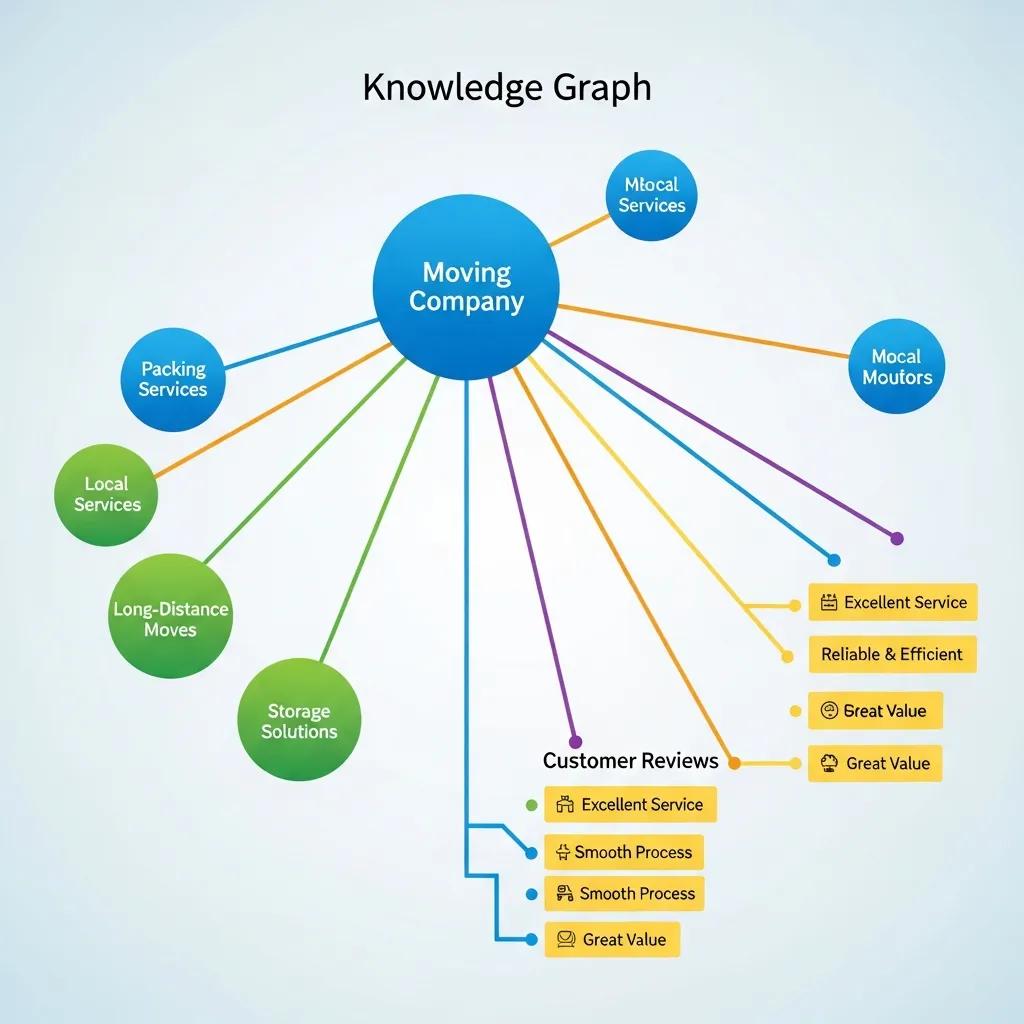
Knowledge Graph SEO is about shaping clear entity identities and relationships so search engines can assemble an accurate graph of your brand, services, locations, and reputation. The approach depends on consistent citations, authoritative references, schema markup, and structured content that resolve ambiguity and link your brand node to Service, AreaServed, and Review nodes. For movers, the payoff is better chances of appearing in knowledge panels, entity carousels, and AI result formats where users receive compact, trust‑weighted answers.
The table below matches core entity relationships with concrete SEO actions you can take to strengthen each connection and produce measurable knowledge‑graph signals.
How Does Google’s Knowledge Graph Recognize and Surface Moving Businesses?
Google’s Knowledge Graph combines signals like consistent business mentions, authoritative backlinks, structured data, and verifiable citations to resolve an entity’s identity and attributes, and then decides whether to display a knowledge panel or entity card. The strongest signals are high‑quality citations from trusted sources, precise structured data that matches visible content, and repeated branded references across reputable directories and media — together they reduce ambiguity and confirm the entity. For moving companies, exact matches in business name, service descriptions, and geographic references across schema, site content, and external citations increase the likelihood a knowledge panel will appear. Those same signals also make AI agents more likely to extract your entity as the single trusted answer for conversational responses.
Which Strategies Build Robust Entity Relationships for Local Movers?
Strengthen entity relationships with on‑site schema, deliberate internal linking patterns, and consistent cross‑domain citations that reference the same entity identifiers and service descriptors. Build a services hub with schema‑rich pages that link to local landing pages; use anchor text that includes serviceType and areaServed to make relationships explicit. Earn citations on local directories and partner sites that reflect your exact name and services, and cultivate structured reviews that mention specific services to tie reputation to service nodes. These steps help search engines and AI models navigate a resilient entity graph that surfaces accurate, trustworthy answers.
How Can AI Search Optimization Future‑Proof a Mover’s Online Presence?
AI search optimization designs content and structured signals so language models and voice assistants can use them as reliable factual units: concise answers, clear entity definitions, and machine‑friendly metadata. Unlike keyword‑first SEO, AI SEO prioritizes semantic clarity with schema, topic clusters, and snippet‑ready content that answers intent in a standalone format. For movers, that means crafting pages LLMs can surface directly — short service definitions, quick procedural lists (how to prepare for a move), and well‑structured FAQs — while embedding consistent schema to supply machine‑readable facts. Below is a practical checklist you can follow to optimize for ChatGPT, Google AI, and voice assistants.
Checklist to align content with AI answer formats:
- Lead with concise, standalone answers: Open each service page with a clear statement an LLM can extract for snippets.
- Include structured summaries and short step lists: Voice assistants prefer short, ordered instructions for procedural queries.
- Keep entity names consistent: Use the same serviceType labels in content and schema so embedding models learn stable vectors.
- Use FAQ schema for Q&A pairs: This boosts the chance your content appears in AI‑generated answers.
Best Practices for ChatGPT, Google AI Mode, and Voice Search
Make it easy for models to extract a full answer quickly: start pages with a one‑line summary, follow with 2–3 short bullets or numbered steps, and include a concise example or cost range when helpful. Expose key facts with schema (serviceType, areaServed, priceRange, aggregateRating) so models have reliable machine‑readable attributes to cite. For voice search, write conversational but precise sentences and include common question phrasings; for retrieval‑focused systems like ChatGPT, provide compact context windows — definitions, examples, and internal links — that broaden entity context. This mix of structured metadata and snippet‑friendly copy raises the odds that AI tools will surface your information as a primary answer.
How Do AI Models Encode Semantic Relationships for the Moving Industry?
AI models form semantic relationships through embeddings and entity vectors that capture which terms co‑occur, how concepts are defined in context, and structural markers like headings and schema. When a mover consistently labels a service “long distance moving” across pages, schema, and reviews, embedding models form a stable vector for that entity and link it to related concepts like “interstate regulations” and “truck logistics.” Structured data provides explicit attributes to complement embeddings, and thoughtfully designed topic clusters give AI systems the contextual breadth they need to answer complex queries accurately. Together, these signals improve the reliability of AI answers and the likelihood that virtual assistants will recommend your business.
Stacked SEO is a marketing agency focused exclusively on serving moving companies. Our offerings include the All‑in‑One Growth Engine (SEO, PPC, AI voice agents, automation), specialized SEO for Movers, and AI Search Optimization for Movers. Key differentiators from our SERP research: deep industry experience, AI and LLM readiness, measurable transparent reporting (including a Profit or Free Guarantee™), and a unified stack that blends SEO, paid media, voice agents, and conversion tracking.
Why E‑E‑A‑T Matters for Moving Companies’ Search Visibility
E‑E‑A‑T — Experience, Expertise, Authoritativeness, Trustworthiness — signals credibility to search engines and AI systems, and it strongly influences whether your content is chosen as the authoritative answer. For movers, demonstrating E‑E‑A‑T means publishing case summaries and process pages that show real experience, detailed procedural content and compliance notes that show expertise, reputable citations that add authority, and consistent reviews and transparent policies that build trust. These elements raise your entity’s trust score in both ranking models and AI answer selection. The next sections give templates and outreach tactics to present E‑E‑A‑T on site and to acquire authoritative backlinks and review signals off site.
How to Display Expertise and Trustworthiness on Your Site
Showcase expertise with process and methodology pages that outline step‑by‑step workflows, safety protocols, and insurance procedures, and pair those pages with bios that name technicians or authors and summarize qualifications. Publish case studies with clear metrics (miles moved, on‑time rate, incidents resolved) and surface customer feedback using Review schema to provide structured evidence. Place bios and case studies in prominent, schema‑annotated sections so both users and machines can verify expertise. These tactics increase the chance that search engines and AI systems treat your entity as a credible source for moving questions.
How Backlinks and Reviews Strengthen SEO for Movers
Authoritative backlinks and verified reviews act as third‑party confirmation of your services — signals knowledge‑graph and ranking systems weigh heavily. Pursue local partnerships, industry directories, and community organizations for contextual backlinks that point to service pages; encourage detailed reviews that reference the specific service and location. Implement a review acquisition workflow — request details like serviceType and area — so reviews feed structured review data tied to entity nodes. These signals boost both local rankings and AI answer credibility.
Stacked SEO is dedicated to marketing for movers. Our main services include the All‑in‑One Growth Engine (SEO, PPC, AI voice agents, automation), SEO for Movers, and AI Search Optimization for Movers. Core value props: industry specialization, AI/LLM future‑proofing, transparent measurable results (Profit or Free Guarantee™), and an integrated approach combining organic, paid, voice, and conversion work.
How to Monitor and Measure Semantic SEO for Moving Companies
Measuring semantic SEO centers on entity‑focused KPIs — knowledge panel presence, rich snippet impressions, AI answer mentions, and structured data coverage — alongside traditional traffic and conversion metrics that prove business impact. Set targets for each entity metric, use tools to track visibility and trends, and run monthly audits to validate schema health and citation accuracy. The table below links entity metrics to measurement tools and suggested targets so you can build a dashboard that highlights gaps and priorities. After the table we outline repeatable processes for continuous monitoring to keep your semantic signals aligned with evolving AI search behavior.
Which KPIs Show Knowledge Panel, Rich Snippet, and AI Visibility?
Track a balanced KPI set that ties discovery signals to engagement outcomes: knowledge panel frequency, rich result impressions and CTR, schema validation rate, AI answer appearance rate, and conversions linked to schema‑enhanced queries. Monitor knowledge panels with weekly SERP checks and brand tools; track rich result impressions and clicks in Search Console and map those to page‑level conversions in analytics. For AI visibility, use specialized trackers or a manual sampling program to log when your content is used as a cited answer. Define realistic targets and tiered alerts so you can prioritize schema fixes and content updates by impact.
Tools and Processes for Continuous Semantic SEO Monitoring
A practical monitoring stack includes Google Search Console for rich result insights, schema validators for markup health, analytics for conversion attribution, and regular manual checks of AI responses and knowledge panels. Maintain a monthly audit cadence to confirm schema coverage, detect inconsistent citations, review internal linking for entity coherence, and sample AI answers to confirm your content is being used. Combine automated alerts for schema errors with monthly strategic reviews to refine topic clusters and content that feed entity vectors, ensuring your semantic signals stay strong as AI search evolves.
Stacked SEO focuses exclusively on movers. Our featured services include the All‑in‑One Growth Engine (SEO, PPC, AI voice agents, automation), SEO for Movers, and AI Search Optimization for Movers. Distinguishing factors: vertical expertise, AI readiness, transparent, measurable outcomes (Profit or Free Guarantee™), and an integrated, full‑funnel approach.
Frequently Asked Questions
What are the benefits of using schema markup for moving companies?
Schema markup makes your site’s facts machine‑readable so search engines and AI assistants can understand your services, locations, and social proof. That improves eligibility for rich snippets, knowledge panels, and higher‑quality clicks. In short: schema helps the right customers find the right information faster.
How can moving companies improve their local SEO using semantic strategies?
Use LocalBusiness schema, create localized service pages, and link them with clear semantic anchor text. Pair that on‑site work with local citations and review acquisition to signal geographic relevance. The combined effect clarifies where you operate and which services you provide, boosting local visibility.
What role does content quality play in semantic SEO for movers?
High‑quality content builds authority and engages users — both of which matter for search and AI selection. Provide helpful guides, detailed service descriptions, and targeted FAQs to demonstrate experience and expertise. When content is useful and well structured, it supports E‑E‑A‑T and increases the chance your pages are used as trusted answers.
How can moving companies leverage AI search optimization?
Create short, self‑contained answers, use consistent entity naming, and expose key facts via schema and FAQ markup. Write conversational yet precise language for voice queries and include succinct examples or cost ranges. These changes help AI systems surface your content in conversational results.
What are the best practices for monitoring semantic SEO performance?
Track entity KPIs like knowledge panel presence, rich snippet impressions, and AI answer mentions alongside traffic and conversions. Use Search Console, schema validators, analytics, and periodic manual AI checks. Run monthly audits to fix schema issues, align citations, and update content based on visibility trends.
How can moving companies build authoritative backlinks?
Focus on local partners, industry directories, and community organizations for contextual links. Create linkable assets — case studies, local guides, guest posts — and participate in community events or sponsorships. Encourage detailed reviews on trusted platforms to strengthen reputation signals that complement backlinks.
Conclusion
Semantic SEO gives moving companies a practical way to improve how search engines and AI interpret their business. By combining focused schema, clear topic clusters, and E‑E‑A‑T signals, movers can increase visibility in rich results and AI answers while driving more qualified leads. Start by auditing your schema, tightening entity names, and building a service hub — those steps deliver immediate gains and long‑term resilience as AI search continues to evolve. If you want help implementing this approach, our tailored solutions are built specifically for moving companies and designed to drive measurable growth.