

Improve UX and SEO: Practical Steps to Lift Rankings and Drive Leads
User experience (UX) and search engine optimization (SEO) work together: UX measures how well your site serves real people, and search engines reward pages that meet search intent with better visibility and more qualified traffic. This guide shows the concrete links between UX signals and ranking outcomes, explains how Core Web Vitals affect conversions for moving companies, and outlines mobile-first, content-driven, and AI-aware tactics that lift engagement and organic performance. You’ll get the metrics to track, prioritized fixes for LCP/INP/CLS, mobile usability patterns for local movers, content and IA strategies that boost readability and relevance, plus how structured data and AI fit into a modern growth program. Each section includes diagnostics, recommended tools (PageSpeed Insights, Lighthouse, Google Search Console), and action checklists so you can prioritize by impact. Examples focus on moving and local services sites, so you can apply these patterns right away to increase rankings and conversions.
How Does User Experience Impact SEO Rankings?
Search engines use observable engagement to infer user satisfaction and reward pages that meet intent. Fast-loading pages, clear information architecture, and smooth task completion (like requesting a quote) all send positive signals that can improve rankings. Better UX reduces friction in the visitor journey, which tends to raise CTR, session duration, pages per session, and conversion rates — the business metrics that drive sustainable organic growth. Knowing these causal paths helps teams choose fixes that move both SEO and revenue.
Our approach at Stacked SEO demonstrates this UX↔SEO mapping: the All-in-One Growth Engine combines technical SEO, content strategy, PPC, AI voice agents, and conversion tracking so UX improvements, content signals, and measurement all accelerate visibility and leads for moving companies. The sections below show which signals to monitor and how typical improvements translate into search performance.
What Are the Key UX Signals That Influence SEO?
Key UX signals are measurable behaviors and page metrics that show whether a page satisfies user intent. You’ll find them in Google Search Console, GA4, and behavior analytics tools. Core metrics include click-through rate (CTR) from search, session duration (dwell time), bounce rate and pages per session (context matters), plus task completion rates like quote requests or calls. Each is captured differently: CTR comes from impressions vs. clicks, dwell time is inferred from session timestamps, and task completions are tracked as events in analytics.
- CTR: Higher CTR means your snippet and meta content match intent.
- Session duration: Longer sessions usually signal deeper engagement and relevance.
- Bounce rate / pages per session: Low pages-per-session can indicate navigation issues or intent mismatch; a single-page visit with a conversion can still be a win.
- Task completion: Form fills, phone calls, and bookings are direct evidence of UX effectiveness.
Monitor these metrics together — improving snippet relevance and on-page clarity typically lifts CTR and dwell time in parallel. Tracking them lets you link UX changes to SEO outcomes and prioritize what moves the needle.
How Do Core Web Vitals Affect Search Engine Performance?
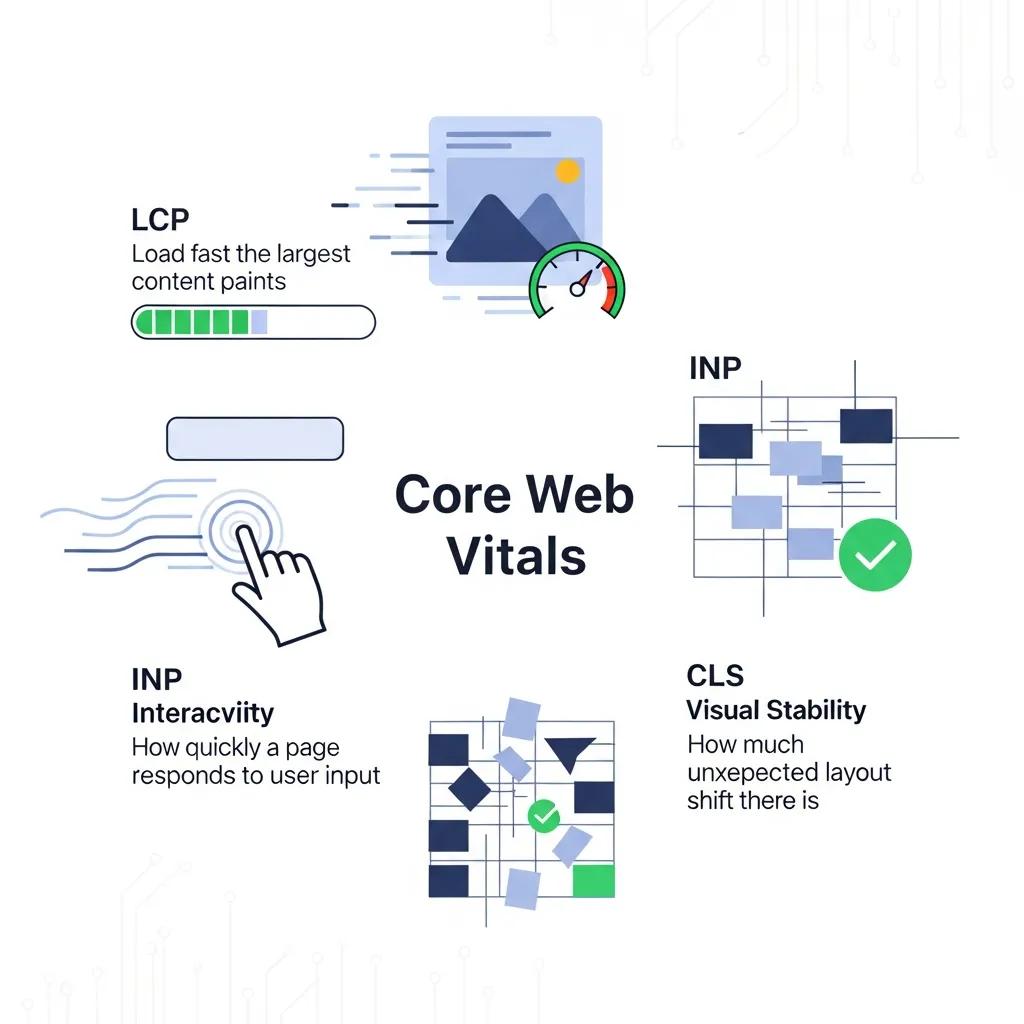
Core Web Vitals — LCP, INP, and CLS — measure loading, interactivity, and visual stability. Search engines use these metrics to judge page quality and user experience. Largest Contentful Paint (LCP) tracks when the main content appears, Interaction to Next Paint (INP) measures responsiveness to inputs, and Cumulative Layout Shift (CLS) captures unexpected layout movement. Pages that meet recommended thresholds deliver faster, more reliable experiences, which reduces pogo-sticking and abandonment and can improve rankings on competitive queries where experience matters.
Research consistently links performance metrics to business outcomes — small improvements in load and stability often produce measurable lifts in engagement and conversions.
Core Web Vitals: Performance That Moves Business Metrics
Fast, stable pages are now table-stakes for user satisfaction and conversions. This paper reviews how web performance tooling measures key metrics like Largest Contentful Paint (LCP) and First Input Delay (FID), why they matter for user experience, and how small delays in LCP, CLS, or FID can hurt bounce rate, conversion rate, and time on site. The findings reinforce that targeted performance work directly supports business KPIs.
Web performance tooling and the importance of web vitals, MK Dobbala, 2022
Use PageSpeed Insights, Lighthouse, and the Core Web Vitals report in Search Console to diagnose issues; these tools surface root causes and prioritized fixes. In practice, improving LCP and INP on transactional landing pages often yields the largest conversion gains, while reducing CLS cuts user frustration and accidental clicks. Use field and lab data to prioritize engineering and design work that delivers both UX and SEO improvements.
What Are Core Web Vitals and How Can Moving Companies Optimize Them?
Core Web Vitals are three user-focused metrics — Largest Contentful Paint (LCP), Interaction to Next Paint (INP), and Cumulative Layout Shift (CLS) — that measure load speed, responsiveness, and visual stability. Moving sites commonly see low scores for predictable reasons: oversized hero images hurt LCP, third-party booking widgets and heavy scripts slow INP, and missing image dimensions or injected content create CLS. Fixing these issues improves perceived performance and eases friction in quote and booking flows, directly supporting conversions.
Start with diagnostics in PageSpeed Insights and the Core Web Vitals report to capture both field and lab data. Those reports reveal which pages and templates create the most friction so you can prioritize high-traffic, high-intent landing pages. The table below summarizes recommended thresholds, common moving-site causes, and remediation actions.
Intro to the CWV comparison table: this quick reference pairs thresholds with typical causes and focused fixes so teams can triage effectively.
How to Improve Largest Contentful Paint for Moving Websites
Focus LCP fixes on getting above-the-fold content visible fast — hero images, headline, and primary booking CTA. Compress and serve images in next-gen formats (WebP/AVIF), use responsive srcset, and preload the main hero asset so the browser prioritizes it. Inline critical CSS for the above-the-fold content and defer non-critical CSS and JavaScript so rendering isn’t blocked.
- Optimize images: compress, use responsive srcset, and serve next‑gen formats.
- Improve server response: use a CDN, cache aggressively, and reduce TTFB.
- Defer or async non‑critical JS and inline critical CSS for above‑the‑fold content.
Image optimization and caching are often fast wins that reduce LCP noticeably. On high‑intent pages, those improvements usually translate into better engagement and more quote requests.
Strategies to Enhance Interaction to Next Paint and Reduce Cumulative Layout Shift
Fixing INP and CLS requires optimizing JavaScript and enforcing predictable layout patterns. For INP, cut main‑thread work by auditing heavy scripts, using code‑splitting, and deferring nonessential third‑party widgets (chat, analytics) until after the page is interactive. For CLS, always declare width and height on images and video, reserve space for ads and iframes, and avoid inserting content above existing elements.
- Declare image and video dimensions to prevent layout shifts.
- Defer third‑party scripts and consider lighter booking widget alternatives.
- Optimize event handlers and reduce long tasks to improve responsiveness.
These steps reduce accidental taps and slow responses that cause abandonment. Validate gains with field data from PageSpeed Insights and the Core Web Vitals report, then iterate on the heaviest templates. Stacked SEO implements these technical fixes at scale for moving companies to deliver stable, responsive pages that convert.
Boost SEO for Local Movers with Mobile-First UX Design

Mobile-first UX aligns with Google’s mobile-first indexing and creates experiences that convert local searchers. Local moving customers want quick actions — call, request a quote, check availability — so mobile pages should minimize taps to key CTAs and surface local signals like service area, consistent NAP, and map integration. Prioritizing mobile performance and usability improves local ranking signals and makes it easier for users to convert from search.
Use the mobile usability checklist below to understand trade-offs and implementation order. The quick-reference table maps common mobile issues to concrete fixes and estimated impact on usability.
What Are Mobile Usability Best Practices for Movers?
Prioritize scannability, fast actions, and simplified forms to turn local intent into leads. Make click‑to‑call, quote, and chat CTAs prominent and tappable. Use a single‑column layout that surfaces services and pricing cues near the top. Design concise booking forms with progressive disclosure and use clear visual hierarchy with short headings and bullet lists for fast scanning.
- Make phone, quote, and chat CTAs highly visible and easy to tap.
- Simplify booking forms: reduce fields, use smart defaults, enable autofill.
- Test across devices and network speeds to ensure quick load times.
When mobile users can find what they need and act within a few taps, conversion rates rise — and search engines pick up that the page satisfies local intent.
How to Optimize Voice Search for Local Moving Services?
Voice search favors conversational, question‑based queries and concise answers. Add natural FAQ blocks and short Q&A sections that answer common voice queries like “nearest movers open now” or “moving estimate in [city],” and mark them with FAQ schema to improve the chance of being surfaced by voice agents. Focus on local modifiers and include service areas, hours, and short, factual answer snippets.
- Target long‑tail, conversational queries with natural copy.
- Implement FAQ schema and short summary answers for voice agents.
- Keep answers concise (one to two short sentences) and factual for voice extraction.
Voice visibility depends on concise answers and consistent local data across listings — pair on‑page content with accurate business listings to improve trust and voice responses.
What Content and Semantic UX Strategies Improve Website User Experience?
Content and semantic UX make your site answer intent and guide users to conversion. Map topics and entities that matter to moving customers — services, pricing, service areas, trust signals — into structured pages and clusters. Clear headlines, scannable sections, and microcopy that anticipates objections (pricing, insurance, availability) reduce friction and increase task completion. Structuring content for entities and intent also helps AI systems and LLMs find and surface your pages for relevant queries.
Start with content architecture that groups research, quote, and booking intent into hub pages with supporting clusters; this builds topical authority and makes internal linking more effective. Prioritize the content UX elements listed below for mover sites.
- Use local modifier headlines and service‑focused subheads for quick scanning.
- Break copy into short paragraphs, bullets, and prominent CTAs.
- Place trust signals like reviews and brief case stats near CTAs.
How to Create Engaging, Readable Content for Moving Companies
Readable content for movers combines clarity, locality, and conversion‑focused microcopy. Use headline formulas pairing service with location, start with a short lead answer for users and AI summaries, then expand with details on scope, pricing cues, and what sets you apart. Use bullets for benefits, short case stats for credibility, and clear CTAs like “Get a fast quote” or “Request availability” near the top.
- Open with a concise lead sentence that answers the page’s main query.
- Use bullets, bolding, and subheads to support quick scanning.
- Keep social proof and conversion CTAs visually close to the lead.
Track readability scores, scroll depth, and CTA clicks to measure content performance; iterate based on these engagement signals to improve UX and organic traffic.
Why Is Information Architecture Important for SEO and UX?
Information architecture (IA) organizes content so users find answers fast and search engines understand topic relationships. For movers, IA supports intent funnels — Research → Quote → Book — using hub‑and‑spoke structures where hubs summarize services and spokes dive into specifics or local pages. This improves internal linking, distributes link equity, and signals topical authority to search engines.
Design IA with clear URL hierarchies, breadcrumbs, and consistent internal linking; match page templates to intent so research pages teach and transactional pages convert. A thoughtful IA reduces friction and improves crawl efficiency so both users and crawlers find your best pages faster.
How Does AI-Driven Optimization Enhance UX and SEO Performance?
AI-driven optimization uses LLMs and automation to interpret intent, surface content gaps, and personalize experiences at scale. LLM optimization means structuring content so AI systems can extract concise, entity‑rich answers while keeping deeper detail for readers. Generative AI accelerates content drafts, creates test variants, and pulls high‑frequency user questions from search data to build FAQ blocks that capture PAA and voice traffic.
Practical uses include predictive intent modeling to prioritize content, automated content scoring to flag weak pages, and AI voice agents that handle booking or quoting. Always keep a human‑in‑the‑loop to preserve expertise and prevent errors, and monitor AI impressions and behavioral conversions to validate impact. These workflows speed up optimization cycles without sacrificing quality.
What Is LLM Optimization and Its Role in AI Search Visibility?
LLM optimization structures content so large language models can summarize it accurately while humans still get full detail. That means short lead answers, clear entity mentions, and well‑organized supporting sections that LLMs can reference for summaries. For movers, provide short service summaries and service‑area mentions followed by details that answer follow‑up questions.
- Put short, direct answers near the top for AI extraction.
- Use entity‑rich phrases (service types, city names, pricing terms) to help AI recognition.
- Monitor AI‑overview impressions and downstream conversions to validate visibility.
Optimizing for LLMs increases the chance your pages appear in AI‑driven search experiences while still serving human visitors with actionable detail.
How Can Generative AI Improve Content Strategy for Movers?
Generative AI speeds up outlines, headline variants, and FAQ drafts that reflect real user queries so you can test and localize quickly. Use AI to create candidate headlines and outlines, then apply editorial review to add local facts and brand voice. For city variants, generate drafts with AI and validate locations and specifics manually to avoid errors.
- Use AI to generate content variants and headline tests.
- Extract user questions from analytics to build targeted FAQs.
- Localize AI drafts with human verification for accuracy and trust.
A human‑in‑the‑loop process preserves E‑E‑A‑T while increasing throughput and enabling systematic experimentation.
How Does Structured Data Implementation Boost SEO and User Experience?
Structured data helps search engines understand entities like business name, services, reviews, and service areas, and it improves SERP appearance with rich results that lift CTR. For movers, LocalBusiness, Service, Review, FAQ, and HowTo schema signal local relevance, highlight offerings, and surface review stars or FAQs directly in search. Accurate property values, consistent NAP, and regular monitoring in Search Console make markup reliable.
Below is a practical schema table mapping schema types to why they matter and mover use cases to simplify implementation decisions.
Which Schema Types Are Essential for Moving Companies?
Priority schema for movers includes LocalBusiness for core local signals, Service for each offering, Review/AggregateRating to surface ratings, FAQ for common customer questions, and HowTo for procedure searches. In LocalBusiness include serviceArea, openingHours, and contact details; in Service describe residential, commercial, and packing services and use priceRange when relevant.
- LocalBusiness: NAP, serviceArea, openingHours.
- Service: name, serviceType, provider.
- Review/AggregateRating: ratingValue, reviewCount.
Implementing these schema types improves the chance of rich snippets and helps search systems and voice agents surface accurate results.
How to Use Structured Data to Achieve Rich Snippets and Better SERP Features?
Add JSON‑LD blocks for LocalBusiness, Service, FAQ, and Review where relevant, validate with Rich Results Test, and monitor enhancement reports in Search Console. Prioritize FAQ and Review markup on high‑traffic, high‑intent pages to lift CTR quickly, then iterate using impressions and click rates in Search Console. Keep markup in sync with on‑page content so search engines trust your data.
- Add JSON‑LD blocks for LocalBusiness, Service, FAQ, and Review where relevant.
- Validate markup with testing tools and track enhancements in Search Console.
- Iterate based on impressions and CTR to focus on highest‑value snippets.
For movers scaling results, consistent structured data plus solid UX and performance creates a high‑impact strategy. If you prefer managed execution, Stacked SEO’s All‑in‑One Growth Engine bundles structured data audits, technical fixes, AI‑driven content strategy, and conversion tracking to drive measurable results. We leverage 15+ years of moving‑industry experience, technology over manpower, and a Profit or Free Guarantee that aligns our outcomes with your success.
If you want measurable growth, book a discovery call with Stacked SEO to diagnose UX and SEO gaps and map a coordinated roadmap for lifting rankings, traffic, and leads. Our All‑in‑One Growth Engine integrates technical SEO, PPC, AI voice agents, content strategy, and conversion tracking into a focused program built for moving companies — speed, industry focus, and outcome guarantees included.
Frequently Asked Questions
What are the benefits of optimizing for Core Web Vitals?
Optimizing Core Web Vitals improves user experience and supports better SEO. By targeting LCP, INP, and CLS you deliver faster load times, smoother interactivity, and more stable layouts — which lowers bounce, raises engagement, and boosts conversions. In short: performance work helps users convert and improves visibility in search.
How can local moving companies improve their mobile SEO?
Make sites mobile‑friendly and local‑ready: use responsive design, speed up pages, and surface key info like contact details and service areas up front. Combine on‑page work with Google Business Profile optimization and local keyword targeting to improve visibility for nearby customers.
What role does structured data play in enhancing user experience?
Structured data makes your content easier for search engines to understand and lets them show richer results — star ratings, FAQs, and service details — that increase CTR. Rich snippets help users find the right page faster, improving satisfaction and click quality.
How can moving companies leverage AI for content creation?
Use generative AI to draft outlines, headlines, and FAQs based on search data, then editorialize the output with local facts and expertise. AI speeds production and testing, but always include human review to protect accuracy and brand voice.
What are some common mistakes to avoid in mobile UX design?
Avoid small tap targets, cluttered layouts, and unoptimized assets. Those issues frustrate users and slow pages down. Keep interfaces simple, prioritize speed, and design for finger‑friendly interaction to improve mobile UX and conversions.
How does information architecture impact SEO and user navigation?
Good IA helps users find answers quickly and helps search engines understand content relationships. A clear hub‑and‑spoke structure, logical URL hierarchies, and consistent internal links improve crawlability, topical authority, and user navigation — all of which support better rankings and conversions.
Conclusion
Improving UX and SEO is a practical, measurable way for local moving companies to increase visibility and drive more leads. Focus on Core Web Vitals, mobile usability, clear content architecture, and structured data — and use AI thoughtfully to scale tests and localization. If you want help executing these tactics, Stacked SEO builds coordinated programs around technical fixes, semantic content, and measurement to lift rankings and conversions. Ready to start? Let’s talk through a roadmap tailored to your business.