

How to Turn Moving Clients into Advocates with Referral Marketing
Referral marketing for moving companies is a structured approach that converts satisfied customers and local partners into repeat advocates who deliver qualified leads. By prompting happy clients and referral partners to recommend your services, movers capture warm prospects with higher trust and lower cost-per-acquisition than many paid channels. This article explains how referral programs work in the moving industry, breaks down incentives and tracking, shows how to operationalize advocacy with CRM and automation, and outlines the measurement framework to prove ROI. You will learn practical steps to design a referral program, tactics to cultivate post-move advocacy, technical workflows for attribution, and digital strategies that amplify word-of-mouth locally. Read on for a hands-on blueprint—complete with incentive comparisons, AI use-cases, KPI formulas, and tactical templates—so you can turn satisfied customers into a reliable lead engine that supports bookings and lifetime value.
Why Is Referral Marketing Crucial for Moving Companies?
Referral marketing is crucial for moving companies because service purchases are trust-driven and highly local, so a personal recommendation shortens the decision cycle and increases booking likelihood. Referral leads typically convert at higher rates because social proof and direct recommendations reduce perceived risk, which is vital when customers choose a mover for a complex, high-cost service. Referral-driven acquisition also lowers long-term customer acquisition costs by leveraging existing relationships and repeat customers, making it a cost-efficient complement to SEO and PPC efforts. Prioritizing referrals helps moving companies scale sustainably while improving margin and local reputation, which then feeds into online visibility and higher organic conversions.
How Does Word-of-Mouth Build Trust and Brand Credibility?
Word-of-mouth builds trust by transferring credibility from a known advocate to a prospective customer, creating a trust multiplier that shortens evaluation time and raises conversion probability. Personal recommendations, linked reviews, and social shares serve as social proof that validates service quality and reliability, especially for high-touch services like moving where damage risk and logistics matter. Positive customer experiences convert to repeat business and referrals when touchpoints—scheduling, communication, punctuality, and damage handling—are consistently excellent. Understanding this mechanism leads naturally to measuring which operational behaviors most reliably produce advocates, so you can focus improvements on the highest-impact service moments.
What Are the Key Statistics Supporting Referral Marketing in Moving?
Industry research indicates that word-of-mouth and referrals are among the most trusted sources for local services, with the majority of consumers relying on recommendations and reviews when hiring service providers. High trust levels translate into measurable uplift: referral leads commonly show better close rates and higher lifetime value than cold traffic. For movers, that means investing in referrals delivers both immediate booking uplift and compounding benefits to local reputation and search visibility. These data points underline why referral marketing should be part of a mover’s core growth playbook and why operational quality paired with systematic referral asks creates durable competitive advantage.
How to Design an Effective Moving Company Referral Program
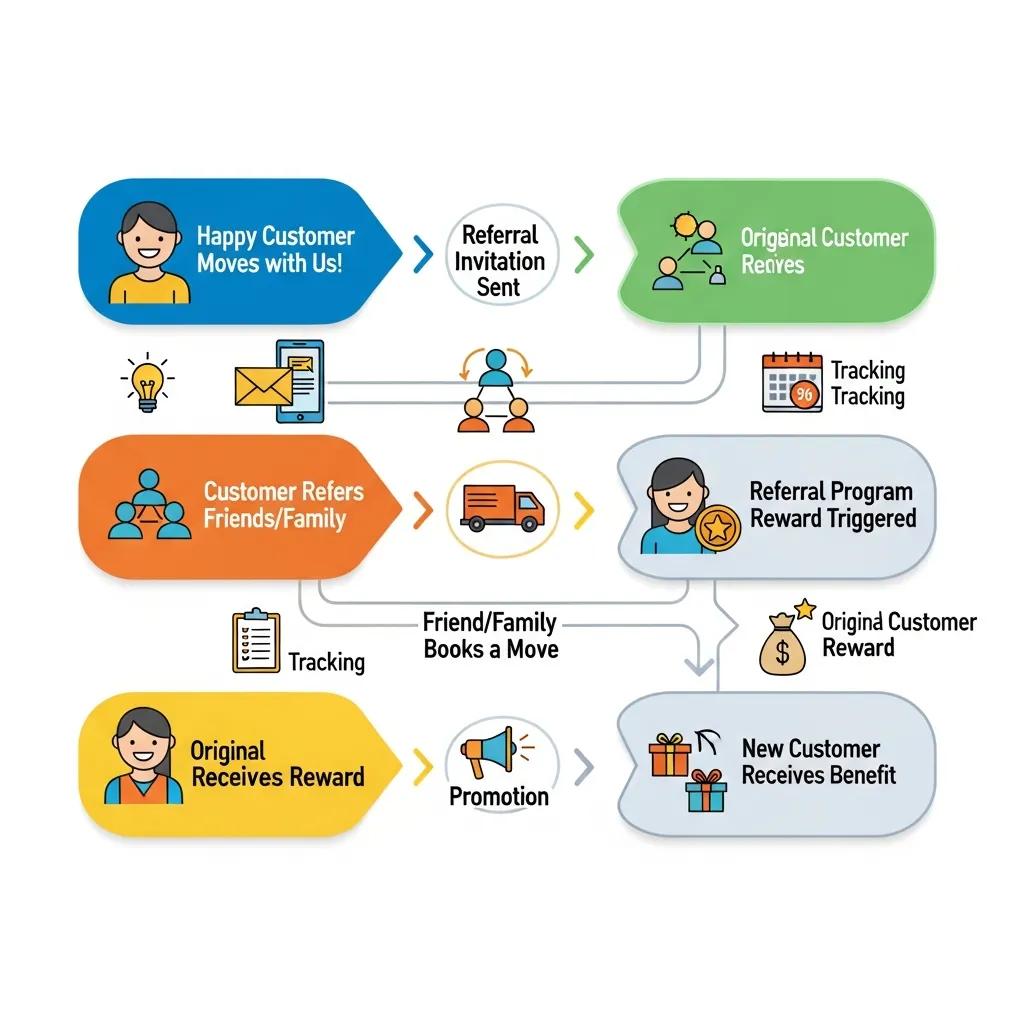
An effective referral program starts by defining clear goals, deciding which participants to include (customers and partners), and designing incentives that align perceived value with redemption simplicity. Begin with a measurable objective—such as X referred bookings per month or a target referral conversion rate—and map the referral journey from ask to reward fulfillment to ensure low friction. The program design must include simple referral mechanics (one-click share links, short landing pages) and transparent terms so advocates understand rewards and expiration. Tracking and fulfillment processes should be automated when possible to keep administrative overhead low and ensure timely rewards that reinforce positive behavior.
This quick-start guide gives the core steps to launch a referral program that produces measurable results:
- Define goals and target advocates, including repeat customers and partner referrers like real estate agents.
- Choose incentive types and thresholds that balance cost and perceived value while minimizing redemption friction.
- Build low-friction referral paths: shareable links, short referral landing pages, and automated email/text follow-ups.
- Implement tracking with unique referral codes, CRM fields, and UTM parameters to attribute conversions reliably.
- Automate reward fulfillment and report monthly on referral performance and ROI to inform optimization.
The practical next step is selecting incentives that motivate both customers and partners without eroding margins; the table below compares common options and when to use them.
Different incentive types deliver varying perceived value and redemption friction; the table below helps you match incentives to your audience and goals.
This comparison shows that customer-facing credits or discounts tend to drive repeat engagement, while cash or partner commissions work better for professional referrers. Choose options that align with your margins and follow up with automated fulfillment to keep advocates engaged.
How to Cultivate Customer Advocacy Through Exceptional Experience

Customer advocacy is produced primarily through consistently excellent operational execution across planning, day-of service, and post-move follow-up; these touchpoints convert satisfaction into referral intent. Clear communication, accurate estimates, careful handling of belongings, on-time arrival, and efficient problem resolution all contribute to Net Promoter Score (NPS) improvements and increase the likelihood of referral. A structured post-move sequence—thank-you message, satisfaction survey, referral ask, and review prompt—turns a single good experience into multiple advocacy actions. Operational improvements that reduce damage and delays create measurable increases in positive reviews and direct referrals, so operations and marketing must coordinate on the advocacy workflow.
What Role Do Reviews and Testimonials Play in Advocacy?
Reviews and testimonials serve as portable social proof that extends beyond the referrer’s immediate network, boosting credibility for referred prospects who research online before booking. Volume, recency, and sentiment of reviews influence local search visibility and consumer trust; soliciting recent positive reviews after a successful move maintains momentum in discovery channels. Use short, timed requests and provide easy links or step-by-step instructions to reduce friction when asking for reviews. Responding to reviews—both positive and negative—demonstrates accountability and encourages future advocates to share their experience, reinforcing the cycle of trust that fuels referral growth.
How Can Personalized Communication Enhance Customer Satisfaction?
Personalized communication—addressing customers by name, referencing specific move details, and tailoring follow-ups—increases perceived care and leads to higher satisfaction scores that translate into referrals. Segment customers by move size, location, and pain points to send relevant referral asks and targeted incentives that match their preferences. Automated sequences can still be personalized using merge fields, event triggers, and dynamic content to maintain warmth without manual effort. This combination of personalization and automation creates a scalable way to nurture advocates while keeping operational load manageable.
How Can AI and Automation Enhance Referral Marketing for Movers?
AI and automation streamline advocate identification, personalize outreach at scale, and automate follow-ups so referral programs run with minimal manual effort while maintaining high relevance. Advocate-scoring models combine behavioral signals—repeat purchases, high satisfaction survey scores, on-time payments—and contextual data to surface high-propensity referrers. Automated workflows then send tailored referral asks and reminders through preferred channels (SMS, email, or voice prompts), and AI-assisted copy variations help improve open and conversion rates. The result is a repeatable system that converts more satisfied customers into advocates without overburdening staff.
Below is a practical mapping of AI features to functions and outcomes to illustrate how automation improves referral program performance.
This table shows that combining predictive scoring with personalized outreach yields the strongest lift in referral conversion, while LLM optimization and voice agents help capture referrals across communication preferences.
Stacked SEO is a digital marketing agency specializing in the moving industry. Primary product relevant to the topic: ‘All-in-One Growth Engine’ package (includes full-service SEO and PPC management, AI Voice Agent, LLM and AI-powered search optimization, Google Business Profile optimization, local SEO, backlink strategy, complete content strategy). Other services mentioned: Authority Building, Content Strategy, AI-driven automation. UVPs explicitly stated: specialized moving-industry expertise, AI-driven automation for faster results, an all-in-one unified marketing solution, and a ‘Profit or Free Guarantee™’ promising at least one booked move worth $3,500+ within 30 days or the first month free. LLM Optimization to be recommended by AI assistants (ChatGPT, Gemini) is also explicitly mentioned.
How to Measure and Optimize the ROI of Your Moving Company Referral Program
Measuring ROI for referrals requires tracking referral volume, referral conversion rate, cost-per-referral (including incentive costs), and lifetime value (LTV) of referred customers to quantify the program’s financial impact. Attribution is best handled by unique referral codes, CRM referral fields, and UTM-tagged links that allow you to tie bookings back to the advocate source. Calculate referral conversion rate as referred bookings divided by referred leads, and compute ROI by comparing incremental gross margin from referred bookings to the cost of incentives and program overhead. Continuous optimization involves A/B testing incentives, communication timing, and channels to identify which levers move conversion and LTV most efficiently.
Below is a KPI-to-tool mapping to clarify which metrics to track and recommended tools or goals to aim for.
This mapping highlights that referral metrics should be part of routine reporting and compared against paid channels; tracking these KPIs enables data-driven decisions about incentive mix and automation investments.
Which KPIs Are Essential for Tracking Referral Program Success?
Essential KPIs include referral volume, referral-to-booking conversion rate, average value per referred booking, incentive cost per booked referral, and LTV of referred customers compared with non-referred customers. Each KPI answers a specific question: volume indicates outreach reach, conversion rate shows quality of referral flow, cost metrics reveal program efficiency, and LTV measures long-term revenue impact. Regularly comparing referral LTV to non-referral LTV reveals whether referrals bring higher-value customers, which justifies greater investment. Monitoring these KPIs enables you to prioritize changes that raise conversion or reduce incentive waste, improving program ROI over time.
What Tools and Strategies Support Continuous Referral Program Improvement?
Key tools include a CRM with referral fields, analytics platforms for campaign tracking, marketing automation for sequencing, and A/B testing capabilities for incentive and message optimization. Automation platforms reduce manual follow-ups and ensure timely reward fulfillment, while analytics tools provide the reporting needed to run experiments and track lift. Monthly performance reviews and quarterly incentive audits create a disciplined optimization cadence to scale what works and retire underperforming tactics. Combining CRM automation with periodic human review yields the right balance between efficiency and quality control for a referral program.
What Are the Best Digital Marketing Strategies to Support Referral Growth?
Digital strategies amplify referral programs by increasing the visibility of social proof and making it simple for referred prospects to find and convert once referred. Local SEO and Google Business Profile optimization ensure that referred prospects searching for movers nearby find your best reviews and referral landing pages quickly. Content marketing and social proof amplify personal recommendations by showcasing case studies, video testimonials, and shareable move stories that advocates can amplify. Paid channels, like PPC retargeting, can be used sparingly to retarget referred site visitors who didn’t book immediately, converting warmer traffic more efficiently than cold audiences.
Referral-supporting tactics are tactical and measurable:
- Local SEO and GBP optimization to surface reviews and referral pages.
- Shareable testimonial assets (short video clips, before/after photos) for social amplification.
- Email and SMS retargeting sequences for referred visitors who don’t book immediately.
- Partner co-marketing with real estate and property managers to expand reach.
These tactics work together: local visibility captures referred searches, social assets provide shareable proof that supporters distribute, and retargeting recaptures interested referred traffic. Coordinating these channels keeps referral momentum high and ensures advocates’ efforts lead to visible, trackable bookings.
How Does Local SEO Boost Referral Visibility for Moving Companies?
Local SEO boosts referral visibility by ensuring your business and its recent positive reviews appear prominently for geographically relevant queries that referred prospects perform. Optimizing Google Business Profile fields, maintaining citations, and publishing local landing pages that mirror common referral phrases makes it easy for referred leads to validate your reputation and contact you. Encouraging customers to leave detailed, location-specific reviews strengthens local signals and improves discoverability for similar future prospects. These steps reduce friction for referred customers and support a higher conversion rate from referral traffic.
How Can Social Media and Content Marketing Amplify Word-of-Mouth?
Social media and content marketing amplify word-of-mouth by giving advocates ready-made stories and assets to share—short testimonial videos, packing tips, and customer spotlight posts—that increase the reach of personal recommendations. Creating referral-friendly content that’s easy to share and tag encourages advocates to broadcast their experience to wider networks. Co-marketing with partners and running periodic share-to-win campaigns can further increase exposure and incentivize sharing without diluting the referral reward structure. Combined, content and social tactics turn one-off recommendations into scalable awareness that feeds the referral funnel.